Sisterhood, Support, and Solidarity: Female-Founded Social Media Networks Offer Authentic and Creative Space for Women

By Karen Gullo

Art by Kseniya Makarova for Seismic Sisters

Art by Kseniya Makarova for Seismic Sisters

Author and women’s activist Tiffany Dufu had her own “crew” of peers, a group of women who gave support and advice, and tapped their networks to help her and each other in their professional and personal endeavors. She knew other women wanted crews of their own but, with busy lives, didn’t have the time to network, attend events to find the right people, forge connections, and organize meetings. Dufu saw a business opportunity to raise up women. In 2018 she launched the social networking platform The Cru, which today has matched hundreds of women with their own crew of professional women with whom they collaborate to meet goals, whether it’s getting a promotion, starting a fitness routine, or finishing a personal project.

Tech entrepreneur and startup founder Gina Pell was looking for a new venture after selling her style guide website Splendora in 2011. Pell, a San Francisco native, and business partner Amy Parker, both of whom began creating online communities years before social media networks were a thing, wanted to offer intelligent, edgy, and interesting online content for women. The result was The What List, a weekly email newsletter about their recommendations for everything from books to skincare products. Pell and Parker’s musings tapped into a need among readers for connection and community, and grew into a private women’s online community called The What Women. Today, over 35,000 members in seven cities share stories, exchange ideas, seek advice, and offer support and friendship on a daily basis. Pell and Parker just launched The What Alliance to connect female-focused brands to What List members.

Gina Pell, The What List co-founder

Gina Pell, The What List co-founder

These are just a few examples of a new kind of social media: women-founded social networks aimed specifically at women. They aim to create safe spaces where members can make friends, share stories, network, talk shop, or seek advice about work issues that they don’t feel comfortable talking about with co-workers. Like Facebook, Twitter, or Instagram, these social networks are a way of connecting online, but the similarities pretty much end there. Most don’t run ads; some are free or charge monthly or annual fees (from $10 a month to $10,000 a year). They are more private, personal, and conversational than the typical social network. A turning point for The What Women was when Pell and Parker posed a question to members: aside from sex, how do you derive pleasure? “By the end of the day we had 1,000 new members,” Pell said. “Women are eager for conversation.”

Jana Messerschmidt, partner at Silicon Valley venture capital firm Lightspeed Ventures and co-founder of #ANGELS

Jana Messerschmidt, partner at Silicon Valley venture capital firm Lightspeed Ventures and co-founder of #ANGELS

Female networks are more about community and less about selfies, more about supporting women than tearing people down, say founders. They don’t allow fights over politics, trolling, or computer-generated algorithms that spoon-feed content to users and control what they see on their feed. Because most are exclusively for women, members don’t have to worry that their male colleagues, HR director, or boss are reading their posts.

On traditional ad-supported platforms, with influencers, product placements, troll wars, and an emphasis on persona-building, “there’s so much noise, it’s never ending,” said Naj Austin, founder of Ethel’s Club and Somewhere Good, social media sites for people of color. “It’s a constant deluge of stuff, and we all feel the need to be around it, to be in the loop,” but to what end? It “creates a very weird sense of self,” said Austin. “You become kind of a character. Women feel like they can’t be themselves.”

Tiffany Dufu, The Cru founder

Tiffany Dufu, The Cru founder

Mainstream social media platforms like Facebook and Twitter, with global reach and billions of users, will continue to dominate social networking for the foreseeable future. But with women looking for networks that foster more meaningful connections, social media startups catering to the female perspective have started cropping up all over the place in the last few years. It’s a growing market that should be a wake-up call for social media entrepreneurs and investors.  

“It’s all about the programming of content,” said Jana Messerschmidt, partner at Silicon Valley venture capital firm Lightspeed Ventures and co-founder of #ANGELS, a woman-founded investment collective that provides capital for start-ups founded by women and people of color. “Being on broad mainstream social media networks is not always a soothing experience.” This has driven people to find new vertical platforms with strong sub-communities—Messerschmidt points to apps like Discord for gamers, Loupe for sports trading cards, and Locker Room for sport’s fans as examples of tight knit communities with well programmed content.

In researching this article, we found over 20 platforms for women, and heard about many more being launched or in the works. The platforms are mostly vertical and cater to specific groups: there are networks for working mothers, job seekers, women reentering the workforce, women of color, black women in tech, female engineers, senior executive women, empty-nesters, female entrepreneurs, mothers with small children, women over 50, and much more. They all have a few things in common: strict rules against bullying, bad-mouthing, and put downs. Trolls get the boot. Bringing your authentic self, being supportive and honest, offering help, sharing your experiences, or just listening are what’s required.

Sarah Lacy,  Chairman Mom founder

Sarah Lacy, Chairman Mom founder

Former tech journalist, author, and entrepreneur Sarah Lacy launched Chairman Mom, a subscription-based ($10 a month) platform for working moms, in 2018 as a place where badass women can get advice about parenting, workplace issues, and everything in between. “I found so much power in being a mother, but never felt comfortable in any online mothers’ group,” said Lacy, a San Francisco resident who has two elementary school-aged children. She wanted a group that was supportive and helpful, not classist or homogenized. A site that celebrates working mothers. “I really needed to build something for women like me,” she said.

Like other founders interviewed for this story, Lacy set out to raise money to start her business, no easy feat for women. The venture capital industry has a massive gender disparity problem. Only 11 percent of VC partners in the U.S. are women. Less than 3 percent of venture capital money invested in startups goes to female founders (yes, you read that right). If your startup’s customers are female, the odds of getting funded shrink significantly, Lacy says. Male VCs who might write a check for a female-founded startup aimed at working women would probably do so based on their perceptions about working women, which is probably way different from the founder’s. “We are not trying to sell anything,” Lacy jokes. “We’re trying to overthrow the patriarchy.”

Naj Austin, Ethel’s Club founder

Naj Austin, Ethel’s Club founder

She initially raised $1.4 million and had an all-women team of developers build software for the platform, where members are invited to respond to two or three curated questions (from members) posted each day. Questions range from how do I ask for a raise to how do I ask if there are guns in the home before letting my child do a playdate at a friend’s home. Lacy says Chairman Mom has thousands of members—most are women but no one is excluded, so there are some men and nonworking women on the platform. Members can join weekly free Zoom group sessions with experts leading discussions about work and parenting issues, or book a one-on-one call for advice with other Chairman Mom members who are career coaches, entrepreneurs, or parenting experts. Lacy raised a total of $3 million since launching, and recently started the Sisterhood Project, a 6-month fee-based virtual course on building community that’s open to Chairman Mom members and nonmembers.

Some female social network startups launched as shared work spaces or private clubs, and had to pivot and go digital because of the pandemic. COVID-19 devastated the economy, and  women have lost the most jobs during the pandemic. More than 22 million jobs were lost in spring 2020 when the pandemic began; a little over half have returned. But as of November, women held 5.3 million fewer jobs than before the pandemic, compared to 4.6 million for men. In December alone, women accounted for 100 percent of the 140,000 jobs lost in the U.S., according to the National Women’s Law Center. Women founders of social network platforms report seeing a surge in membership and engagement since the pandemic, as women seek support and connection in online spaces.
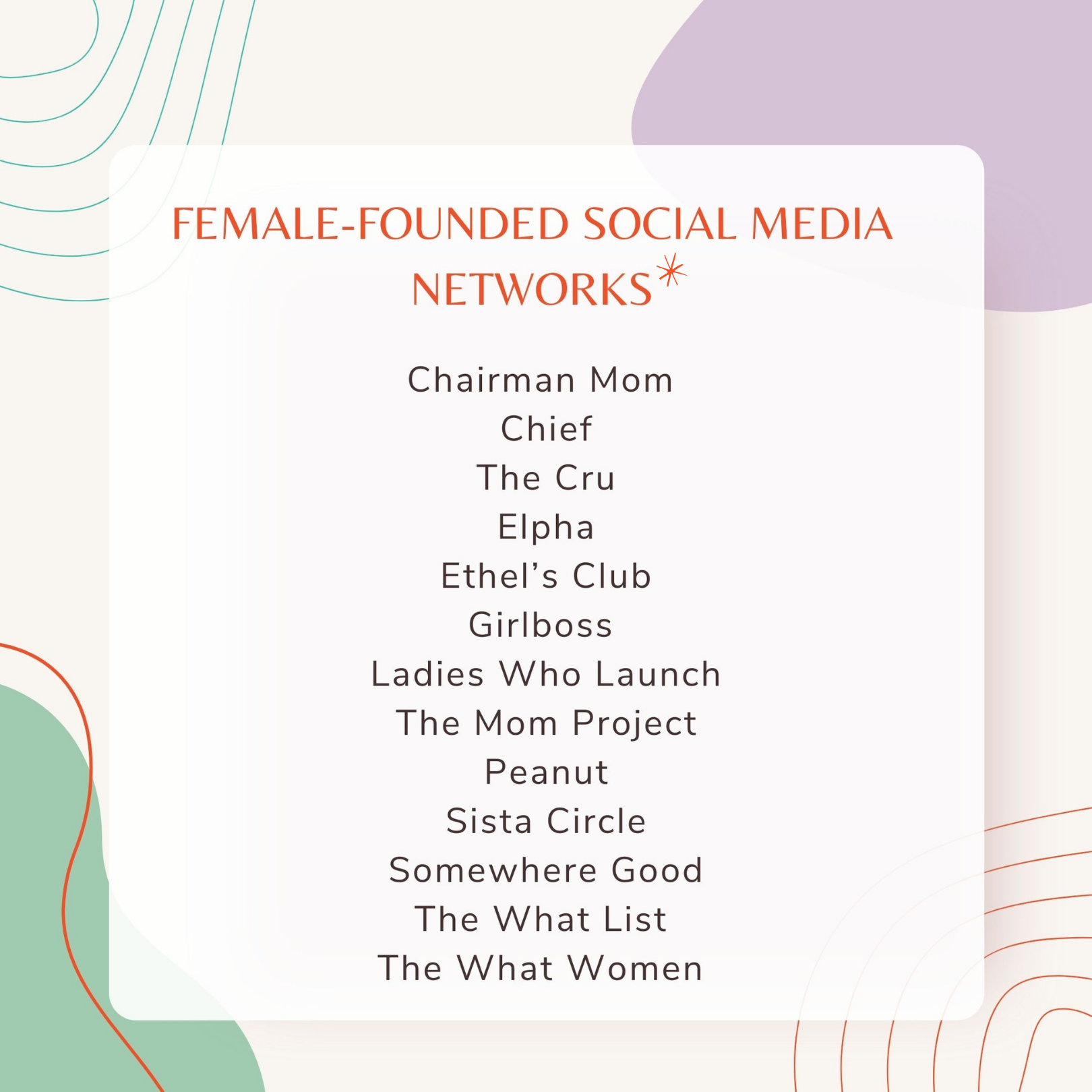
Seismic Sisters went in search of creative social media networks founded by women and these rising stars grabbed our attention!

Seismic Sisters went in search of creative social media networks founded by women and these rising stars grabbed our attention!

Brooklyn-based Ethel’s Club, a 4,700 square foot social club for people of color with a boutique, kitchen, yoga studio, café, and open meeting space launched in 2019, was thriving with 250 members and thousands on a waiting list when the novel coronavirus ended in-person group gatherings. The physical club shut down. Austin, 29, who had raised $1 million through crowdsourcing and funding from author Roxane Gay and others, knew she had to pivot. She believed that, with workers losing jobs, suffering financial hardship, and experiencing illness and isolation, it was imperative for people of color to have a space to gather and support each other without the harassment and racism they experience on mainstream platforms. Ethel’s Club, named in honor of Austin’s grandmother Ethel Lucas, the matriarch in a tight-knit Black community whose home and kitchen were gathering places, went digital in the spring of 2020 and introduced a $17 monthly subscription (membership fees had been $65 or $195 a month depending on features) that includes thrice-weekly events featuring Black and Brown wellness professionals, caregivers, writers, artists, therapists, teachers, and more. Conversations about systemic racism and police brutality that dominated headlines following George Floyd’s death brought many to the platform, which has a national membership of over 1,000. The majority are millennials, but Gen Zs and a 50+ crowd are also on the platform.

“We have been able to be in the right place at the right time,” said Austin.

She also launched the site Somewhere Good, an offshoot of Ethel’s Club that connects people of color based on their interests and identities. You’re invited into small groups (Austin says it’s like being invited to a very intimate dinner party) and the platform creates a timeline and newsfeed that’s curated from the select communities you decided to join.

The platform has a strict, zero tolerance policy against discrimination and harassment, and limits users’ ability to post on someone’s feed. Members are allowed to follow others only after they’ve had multiple interactions. “This makes it more real,” said Austin. You wouldn’t follow someone around in real life after meeting them once; the policy encourages people to get to know one another.

Somewhere Good also connects members to black-owned businesses and services, from skincare and clothing to podcasts and galleries. The rest of the Internet was not built with people of color in mind, but this platform is, Austin said. “There’s a new urgency to have every aspect of your life reflect your ID,” she said.

Mai Ton, tech industry HR executive

Mai Ton, tech industry HR executive

New Yorker Mai Ton has been a senior human resources executive in the tech industry for a decade, and is used to being the only woman, and minority, in a room full of white men. She joined Chief, a social club and network for high-level executive women, for one simple reason. “I got tired of never being among women and only being around men,” she said.

Chief, founded by Carolyn Childers and Lindsay Kaplan, both former senior level executives at e-commerce companies, launched in 2019 with the opening of a private club in New York’s Tribeca neighborhood. With a mission to connect and support senior women leaders, Chief filled a void and took off, garnering more than 2,000 members from top U.S. corporations, with several thousand more on a wait list. Only executive women or rising vice presidents can apply to join (or be nominated by existing members). Childers and Kaplan have raised $40 million in venture funding. Membership costs $10,000 a year (members’ employers often pay the fee).

When the pandemic hit, Chief shifted to all online services and events—monthly peer group meetups, leadership workshops, presentations by industry icons, and one-on-one coaching. Members can chat on a community platform with over 40 channels on topics like diversity and women in tech.

“I’ve gained a lot of connections and comradery that I wouldn’t have otherwise,” said Ton, chief people officer at Kickstarter. “Members are very seasoned women who have made it in their careers and want to help others.” Chief pairs members with a core group of about eight people, led by a professionally-trained coordinator, who meet monthly to discuss work issues and get feedback and advice. Ton said she worked with a coach who helped her get “unstuck” on an issue, and garnered four new clients, whom she met on Chief, for her consulting business. “This is your tribe. It’s like having a small group of advisors,” she said. “We utilize and help each other.”

Alexandria Noel Butler, Sista Circle founder.

Alexandria Noel Butler, Sista Circle founder.

While working as a project manager at Airbnb, Alexandria Noel Butler was grappling with how to be more direct with co-workers after receiving feedback from a good friend, who happened to be a white male colleague, about her management style. His advice was: don’t mince words, just be direct and don’t worry that people may not like it. “I said, I can’t do that,” Butler remembers. “I’m a dark-skinned, curly-haired Black women, and I can’t walk into a room and talk to people the way he talks to people.” She had to figure out her own way of being direct, as a Black woman working at a mostly white male company. What she wanted was advice and feedback from other Black women managers. But this is Silicon Valley, which employs very few people of color. A recent study from San Jose State University revealed that ten large tech companies in the valley had no Black women employees (the report didn’t name the companies).

“I had to find someone who looks like me and shares my experience,” said Butler, senior program manager for data and privacy at Twitter. So, in 2017 she started a Facebook group called Sista Circle: Black Women In Tech. It started with a few of her friends who also invited their friends. Butler’s goal was to create a safe space online where Black women in tech can make connections and network, but also discuss the challenges and struggles of being a woman of color in Silicon Valley. Now, almost four years since it launched, Sista Circle has 7,700 members from around the world. It’s a sounding board and gathering place for Black women in tech, with discussions about work, life, relationships, kids, you name it, says Butler, now a senior program manager at Twitter and speaker and advocate for women in tech.

“Sista Circle helped me be more honest and helped me figure out how to have difficult conversations,” she said. “It’s given me permission to be myself. That’s what I hope this community gives other people.”


Karen+Gullo+for+Seismic+Sisters.jpg

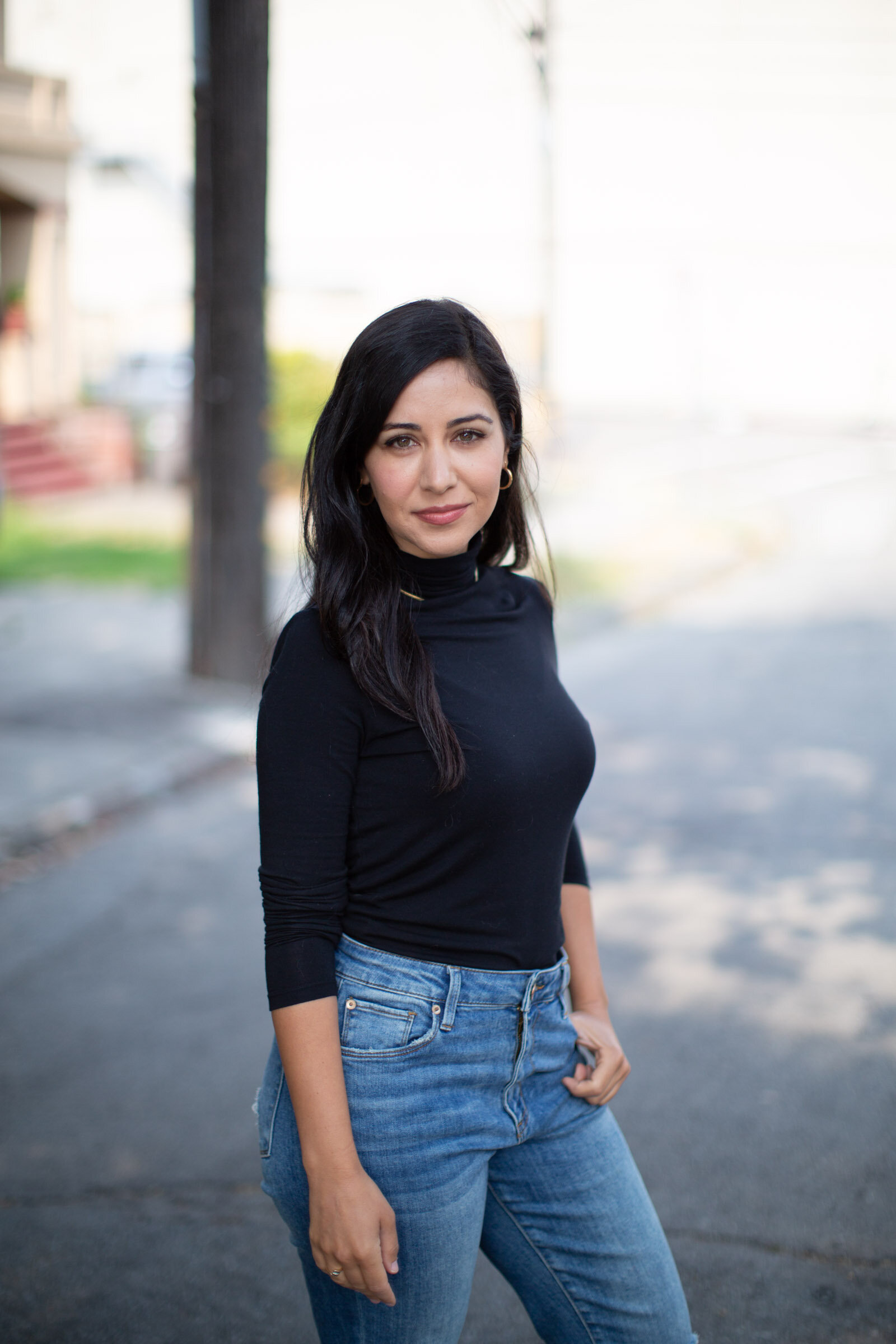
Karen Gullo is a freelance writer and former Associated Press and Bloomberg News reporter covering technology, law, and public policy. She is currently an analyst and senior media relations specialist at Electronic Frontier Foundation (EFF) in San Francisco.


*This list of networks, organizations or social media platforms (the “Platforms”) is for entertainment, education and reference purposes only.  Seismic Sisters and the author do not guarantee or endorse the Platforms. Seismic Sisters is in no way affiliated or “materially connected” with the Platforms. Seismic Sisters has no responsibility for any of the Platforms’ operations and services or influence over any of the Platforms’ independent content and public commentary. Use the Platforms at your own risk.

The Intimacy of Friendship

By Keesa Ocampo & Sydney Williams

Screen Shot 2021-02-14 at 7.36.10 AM.png

Love is in the air and in this time when we’re either in (very) close quarters with our partners or isolated from our friends, we’re forced to evaluate the quality of our relationships. We find ourselves asking whether a relationship is worth our time and effort while we also endure the eye strain from our screens, the annihilation of any semblance of work-life balance, and the (fill in the blank) of everyday pandemic life. 

If there are guides aplenty on steps to take to get thousands of friends on social media and more ways to connect with new platforms like Clubhouse, then why are millions of women around the world still saying they are dissatisfied and lonely? We want to know - how can relationships become more satisfying?

Although friendship does not have a roadmap, women like Shasta Nelson are certainly doing their part in helping us learn how to deepen the intimacy of our friendships so we can stop feeling so alone. “The truth is that few of us have ever been taught how to foster friendships and that’s resulting in nearly 75% of us feeling dissatisfied with our friendships,” she shares. “There is some amazing science that can help us build the bonds we crave!”

Screen Shot 2021-02-14 at 7.35.32 AM.png

It seems to become increasingly difficult to make friends as adults, but deeper and more meaningful friendships are possible to nurture, whether it’s with casual acquaintances we already have or with people we know from work. Shasta dedicated her career to friendships and began formulating ways that they can be improved and made. “I had studied a lot of psychology and poured over any research I could find that might be helpful to all of us who were trying to make friends as adults.” The bestselling author recalls, “My first book Friendships Don’t Just Happen came out in 2013 to not only inspire people to pay attention to their relational health without shame, but to then know what steps could help them make new friends. A few years later, I wrote Frientimacy: How to Deepen Friendships for Lifelong Health and Happiness because I saw that most of us aren’t lonely because we actually need to meet more people, but rather because we crave deeper friendships with a few. Most of us wish our relationships felt more meaningful but we don’t know how to make that happen! And my third book, The Business of Friendship just came out a few months ago, teaching us what research shows about why we need friends at work and how we can appropriately develop those relationships.” 

love

So if there’s a way to get friendships to feel more real and satisfying, why are so many of us still lonely? Shasta explains that, “What’s important to know is that loneliness is just an emotion telling our body that we have an unmet need, much like hunger, thirst, or exhaustion. It’s not something to feel shame over at all. We all feel lonely when we need more love! The healthiest and happiest among us though will receive that message from our body telling us we are hungry for more support and love and will ask - What kind of connection will help nourish me right now?” So the answer is, it isn’t you. It isn’t them. It’s that we probably haven’t checked in to identify what’s missing. 

The options are threefold and quite simple. Based on all the social science on what makes for good relationships, Shasta identified the 3 Relationship Requirements and teaches them on a triangle: Positivity + Consistency + Vulnerability. Depending on how much is practiced, a friendship has the capacity to ascend to different levels of intimacy. More importantly, if there’s a relationship that you feel isn’t working right now, chances are that at least one of those is missing.

The pandemic has done more than change our everyday fashion and the contents of our pantry. It has made isolation so much easier. It’s sometimes made the need to keep friendships pleasant more important than the need to keep them real. If you’re looking for something more meaningful than the “I hope all is well” text or email, Shasta advises to “...write on a post-it note the names of a handful of people who you wish you were closer to and identify which of the 3 requirements (more positive emotions, more consistent interactions, or more shared vulnerability) would leave you feeling better in that relationship. Then start trying to incrementally practice adding it! And, don’t be shy about reading a book to help guide you. Remember, none of us have been taught, and yet all of us have this as a human need— it’s worth studying and being intentional.”

For some, the physical distancing has left more opportunities to develop more frientimacy. Whether it’s the added consistency of more regular walks or Zooms or the added vulnerability to admit that we’re at wit’s end, we know one thing to be sure: Never have we ever needed more friends and a network of support than now.  

No exception to the rule, the Seismic Sisters team has faced the need for more frientimacy as much as you. This is our homage to our friendships and ways that we’ve been deepening our friendships while staying six feet apart. For the month of love, we wish you more frientimacy. 

seismic sisters best friends

Sydney & Shelby

Shelby and I met my first week after moving to Oahu, Hawaii. We spent five years hip to hip, going to school, bonding over great food, and feeling like children again playing in the sand. Since moving home to the Bay Area and not being able to return to the island easily to visit, Shelby and I have weekly facetime calls and send comical and encouraging messages to each other daily. Shelby makes me feel fulfilled and loved because no matter what we are going through, she is always there to support me. She is one of the most consistent parts of my life and I am very thankful for her friendship. 

kim c and uzuri

Kim & Uzuri 

Our friendship was born out of love for community activism and hyper-local politics. Whether it’s running for office, running a campaign or starting a new organization, we boost each other’s ‘stretch’ projects. We stay connected through our work to uplift each other and our neighborhood and have fun doing it. #powerplayers #sheshowsup

Tumay and Libby.JPG

Tumay & Libby

I met Libby at the age of 16 when I had just moved to America from Turkey. She took me in as her own family and now 20 years later she is still my soul sister. Even though we’ve lived in far away cities, gone down our own paths in life and sometimes didn’t speak for months, I’ve always felt her unconditional love for me. She's been able to overlook all the small things that don’t matter and love me for who I am. With her in my life, I’ll never feel truly lonely. 

Photo by: Manjula Nadkarni

Photo by: Manjula Nadkarni

Ayesha & Keesa

We send love through food and found ways to find meaningful work together. But more importantly, we have regular honest catch ups, whether they're virtual or distanced. Being able to say - I'm not okay - and know that we can count on great advice, no judgment, and laughs, has proven that no pandemic can keep this friendship from blossoming!

Polina Smith with her best friend

Polina & Eva

My best friend Eva moved to Berlin a year and a half ago. I miss her dearly but am SO grateful for Whatsapp audio messages that allow me to feel deeply connected to her across different time zones and a vast ocean!

Screen Shot 2021-02-14 at 7.37.35 AM.png

Sofia & Jacob

We’re finally in the same city after a long time but still can’t really hang out. We have impromptu FaceTime calls and chat endlessly about life, boys and work to stay in touch and up-to-date on recent happenings. It’s so nice having a friend to connect with so freely. We are lucky to have found one another in this crazy world. 

Never Forget: Holocaust Remembrance Day 

By Sydney Williams

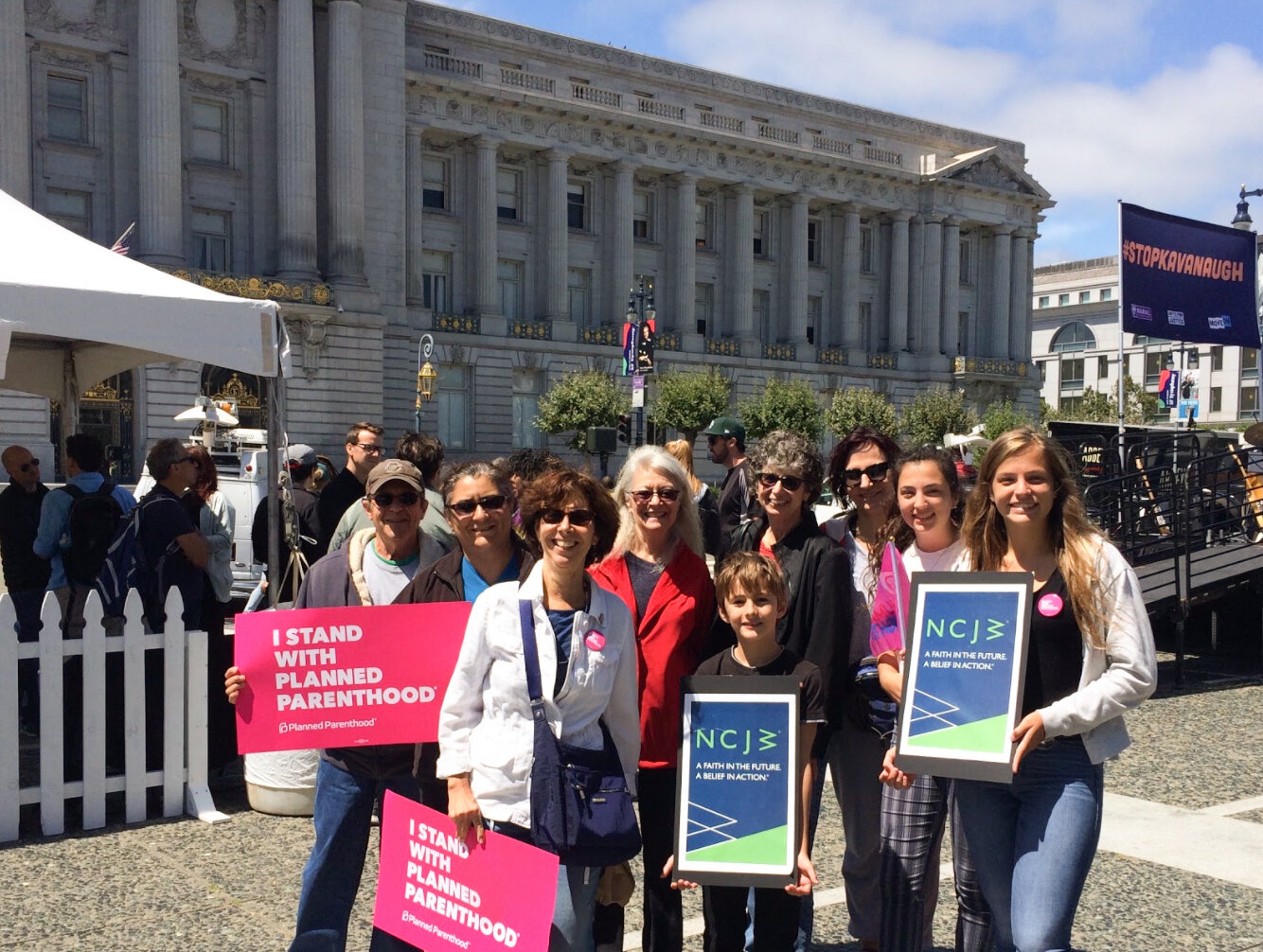
National Council of Jewish Women - San Francisco gather at the Women's March  Photo by Antonia Lavine.

National Council of Jewish Women - San Francisco gather at the Women's March 
Photo by Antonia Lavine.

Holocaust Remembrance Day is among us, and so are the scars left behind by the anti-Semitic events of World War II. In 1933, the Nazi regime came into power with a racial superiority complex that lead to the death of 6 million Jews in concentration camps and military attacks. This hateful, systematic, and state-sponsored campaign took tens of millions of souls from us during its reign. A time that will forever remain a stain on our global history, and a pain in our hearts. Once a year (but for some of us, far more than that), we commemorate the lives lost and the wounds to society left behind by the Holocaust. 

In honor of Holocaust Remembrance Day, Seismic Sisters spotlights an active and influential organization in the Bay Area:  the National Council of Jewish Women (NCJW) - San Francisco. For over 120 years, the NCJW San Francisco has dedicated itself to uplifting not only Jewish women, but all members of their community regardless of faith or gender. Their leadership team, made up almost entirely of women advocates, strives for a society where just is ≠ justice (as poet Amanda Gorman so eloquently put it during the Inauguration ceremony). Their core areas of advocacy are civic engagement, empowering women, fighting human trafficking, and advancing social justice in Israel. They strive to be a platform for education, assistance, and action against injustices in the Bay Area and beyond. With the help of organizations like the NCJW San Francisco, we take lessons learned from the past to pave righteous paths towards the future. 

Katie Koyfman, NCJW San Francisco Board Member and Chair of ‘Next Generation’ Committee. Photo by Katie’s husband, Jake Ososke.

Katie Koyfman, NCJW San Francisco Board Member and Chair of ‘Next Generation’ Committee. Photo by Katie’s husband, Jake Ososke.

Katie Koyfman, a member of the board of directors and chair of their Next Generation committee, is a rising star in the NCJW San Francisco’s leadership team. Katie first joined forces with this organization as a member of the very committee she now chairs and was the youngest member ever invited to sit on their board of directors. We are delighted to share her thoughts from our interview to learn more about NCJW San Francisco, and as we commemorate Holocaust Remembrance Day.

What inspired the establishment of the ‘Center for Women and Girls’? 

The NCJW San Francisco’s Center for Women and Girls was founded in 2013. Its main purpose is to protect women and children at risk by providing them with a safe place of support. With initiatives such as lobbying services to support foster families, giving scholarships to prospective students, advocating for paid family leave, and hosting events for women in the workforce to connect, the center has a considerably widespread impact. A notable achievement of the Center for Women and Girls is their involvement in achieving justice for victims of child prostitution. They played a large role in the passing of legislation for the decriminalization of child prostitution. This made it so that children will no longer be held responsible for their abuse. In addition to the Center for Women and Girls, the NCJW SF has two more groups working towards a similar goal:  The San Francisco Collaborative Against Human Trafficking and The Jewish Coalition to End Human Trafficking. 

Vote Against Violence rally at San Francisco City Hall.  Photo by Antonia Lavine

Vote Against Violence rally at San Francisco City Hall. Photo by Antonia Lavine

What change is the ‘Jewish Advocates in Action for a Critical COVID-19 Response’ council bringing to the community? 

First, it is important to know that the Jewish Advocates in Action for a Critical COVID-19 Response is a youth-led council. Our mission at NCJW San Francisco Next Generation is to create a space for young adults to bring their ideas to the table and to foster their passions through volunteering. High school senior twins Emma and Julia are part of NCJW SF Next Generation and lead the council in an effort to open channels of communication to discuss adversity brought about by the COVID-19 pandemic. They have made leaps and bounds with this council. One of their many accomplishments thus far has been launching a webinar series. Each webinar is focused to address a different topic. Topics range from the impact of COVID-19 on human trafficking survivors to individuals with developmental disabilities, from Israeli democracy to the impact of stay-at-home policies on victims of domestic violence. Emma and Julia have truly gone above and beyond in connecting people in need with resources to help. 

Emma and Julia (two farthest right), leaders of Jewish Advocates in Action for a Critical COVID-19 Response council. Photo by Antonia Lavine

Emma and Julia (two farthest right), leaders of Jewish Advocates in Action for a Critical COVID-19 Response council. Photo by Antonia Lavine

How do you commemorate Holocaust Remembrance Day? 

I spend the day with my family, namely my grandparents, who are Holocaust survivors. My grandpa is a notoriously hard worker, diligent about his commitments and passionate about his endeavors. They have so many reasons to hate the world, but they are the most kind, loving, caring, and giving people that I know. Living through the Holocaust caused them so much pain - pain that they still live with today, but it in fact taught them forgiveness and patience. It made them want to be better than the people that imprisoned them. As a family, we choose to commemorate this day of loss by celebrating what we do have. It was a bone-chilling event in history, but a heart-warming opportunity for family to come together. 

If there was one message you could share with the world, what would it be?

“When looking at the last year, I would describe it as a whirlwind where I felt anxious and frozen, yet hopeful and inspired all at the same time. At first, I stared defenselessly as my idea of ‘normal’ crumbled. I looked for the helpers like Mr. Rogers said to do in his beloved children’s show. But as adults, we no longer have the luxury to only search for helpers. We must be the helpers we are looking to find – it is our civic duty. We are not powerless. We are strong and resilient. Our strength is rooted in empathy and the source of our power is in helping others. Being engaged with a group making a positive impact on people and policy is how I rediscovered my strength. NCJW SF is working tirelessly to improve the lives of women, children, families, and those most vulnerable in our economic and health crisis. Through education, collaboration, and advocacy, we are fighting for equity and tackling hate, racism, and anti-Semitism. Whether through being an ally, advocate, or activist, we can challenge bias and build bridges of understanding. I am privileged to advance NCJW SF’s mission, support our community, and create a future where justice prevails.” - Katie Koyfman

For more information on the National Council of Jewish Women San Francisco, visit www.ncjwsf.org

This interview has been edited for length and clarity.


SEISMIC SISTERS GIFT SHOPPING GUIDE: Products Made and Curated by Women

 
Candelario Design for SS (1).jpg

Here at Seismic Sisters, we love to support women-owned businesses. This is our first annual Seismic Sisters Gift Guide, showcasing products made and curated by women. Do your holiday shopping and invest in women’s economic growth! Support these talented women with your wallet!

Curated by Tumay Aslay and Polina Smith

 
Alex Steele Studio.png

Alex Steele Studio

A Creative soup of paintings, murals and wearable art. ALEX STEELE STUDIO is the artist’s evolving endeavor in visual expression.

OAKLAND, CA

blk girls green-house.jpg

BLK Girls Green House

Blk Girls Green House is the brainchild of two Oakland women Kalkidan Gebreyohannes and J’Maica Roxanne—committed to collaborating with fellow Black-owned businesses and inspire conscious, local shopping and gathering.

OAKLAND, CA

Female and Black Owned- Mc Mullen.png

Mc Mullen

Founded 2007 by Sherri McMullen in Oakland, this female and black owned business is an all inclusive concept shop for luxury womenswear featuring emerging and established designers from around the world. McMullen has a commitment to supporting African and African-American apparel and home décor designers.

OAKLAND, CA

Candelario elephant earings.jpeg

Candelario

Candelario is a fresh, alternative jewelry line that arose from an ideal balance of passion, creativity and sustainability. The brand is eco-friendly incorporating recycled materials from post industry use in Colombia into the designs. Launched in 2017, Candelario embodies the modern, self-empowered woman who celebrates femininity, good energies and sustainable fashion.

SAN FRANCISCO, CA

cloutierceramics

Cloutier Ceramics

Her handmade ceramic work focuses on handheld sculptures, functional wares and everyday objects.

NORTHERN CA

Faye Kendall.png

Faye Kendall

Fiber work and wearable sculpture inspired by natural phenomena great and small - from lunar cycles to tiny ocean creatures.

SAN FRANCISCO, CA

Take Shape Studio.png

Take Shape Studio

Using playful shapes and impactful lines, jeweler Sophie Silverstein of Take Shape Studio designs jewelry inspired by visual observations, symbols, tactile experiments, and nature.

SAN FRANCISCO, CA

Prism Jewels.png

Prism Jewels

Raw crystals and sacred geometry for the modern femme.

BERKELEY, CA

MirandaEvens.jpeg

Miranda Evans

Working primarily with watercolor paint, she is interested in exposing inner conflicts, resolutions and evolution through self portraiture and symbolism. Her shop includes paintings and prints of her work.

LOS ANGELES, CA

kalmkorner.jpg

Kalm Korner

Kalm Korner is a Black & Woman-Owned conscious lifestyle brand and luxury gift line. We offer a variety of clean & food-grade self-care products as well as business opportunities that enhance & expand the lives of women of African descent & their families around the globe.

OAKLAND, CA

Photo+of+Sharon+Zimmerman+-+Image+Credit+-+Ryan+Leggett.jpg

SHARON Z JEWELRY

Badass fine jewelry for the modern human. I use recycled and Fairmined gold & silver, traceable & ethical gemstones in my jewelry. I make the most out of these precious resources. My jewelry is meant to be worn and enhanced by each wearer's personal expression.

SAN FRANCISCO, CA

Polina Posters.png

Polina Smith

Posters and stickers inspired by amazing women leaders. All profits go to EMERGE, whose mission is to increase the number of Democratic women in public office through recruitment, training and providing a powerful network.

MARIN COUNTY, CA

Tiny Forest Photography San Francisco Bay Area Maternity Photos

Tiny Forest Photos

Tumay Aslay is an award-winning fine art portrait photographer based in the San Francisco Bay Area. Her portrait work is deeply intimate and vibrates with feminine energy. Her subjects ranges from powerful women leaders, human rights protests to astonishing family portraits.

SAN FRANCISCO, CA

Baby Cats of CA copy.png

Baby Cats of California

Baby Cats of California is cute clothing for adults, kids and babies. The owner Kat Karnaky puts forth designs that stay true to her own aesthetic. Designed in Oakland and made with love.

OAKLAND, CA

annamonetjewelry.JPEG

Anna Monet

Contemporary Fine Jewelry

Created with ethically gathered horsehair and natural dyes, designed with intention and integrity.

SAN FRANCISCO, CA

VIRTUEVISION.JPEG

VIRTUE VISION

Sharon Virtue is an agent of transformation. Her mission as an artist: to inspire, encourage and provide access to everyone in the creation of art. Her work has two strands, one as a dancer and artist, creating paintings and ceramics, and the other as a creative community activator, teaching expressive arts workshops and facilitating community development projects.

OAKLAND, CA

Clean goods for aromatherapy.png

Candle Therapy

CandleTherapy, the clean candle for aromatherapy.

SAN FRANCISCO, CA

Conor Hagen + the model is Angelyne Thompkins.jpg

Born to Roam

Born to Roam Vintage is a curated collection of men and women's vintage clothing made between the 1960s and 1990s. All pieces are inspired by a deep love of California subcultures.

OAKLAND, CA

charmaineolivia.png

Charmaine Olivia

Spirituality, mysticism and mythology are strong influences in her work and in her life. Charmaine is aware that there is more to this physical world than we can see with our eyes, so she uses painting as a means to explore the other dimensions of mind and thought.

SAN FRANCISCO, CA

Coyote Brush Studio.png

Coyote Brush Studios

California inspired stickers, prints, greeting cards, zipper pouches, temporary tattoos, and more! Handmade with love in the golden state.

SAN FRANCISCO, CA

Tactile+matter.png

Tactile Matter

The artist Kenesha Sneed is the fierce black woman behind Tactile Matter. Her shop offers a collection of handmade ceramics, illustrations full of female empowerment and colorful home goods! Sneed’s work has many creative layers and we can’t wait for you to check them out!

LOS ANGELES, CA

Non Disposable Life.jpg

Non

Disposable Life

Molly de Vries, the creative force behind Ambatalia, aims to facilitate a considered way of living that eliminates the unnecessary waste of single-use products. Crafted from lovely, natural, and sustainable materials, all textiles are proudly made in the San Francisco Bay Area.

MARIN COUNTY, CA

noirenourishment

Noire

Nourish

ment

Noire Nourishment is a black owned business with black womxn in mind. The owner Amber Julian creates products with the intention of bringing peace into your self-care routine. All her products are homemade with local ethically harvested herbs and plants. We hope that you enjoy these natural body and hair products made with love!

SAN FRANCISCO, CA

Goldie Blox

GoldieBlox

GoldieBlox is a media and entertainment company using storytelling to make STEM fun. We educate and empower young girls by creating engaging content, fun toys and interesting resources that will help build their confidence and their dreams.

SAN FRANCISCO, CA

image0.png

Clay Momi

The SF based artist Erin M M Sweeney is the woman behind Clay Momi. Her shop offers handmade clay creations full of bright joyful colors and floral designs. Her work ranges from planters to coffee mugs and much more.

Pearls of imperfect beauty and joy.

SAN FRANCISCO, CA


Seismic Sisters does not endorse any of the Seismic Sisters Gift Guide products or services nor does it guarantee the quality, merchantability, appropriateness or availability of the products or services listed in the Seismic Sisters Gift Guide (or any other products or services sold on the linked websites).

The links are only provided as a courtesy to allow access to the referenced sites. It is your choice whether or not to purchase such gifts or services. Seismic Sisters will not make any money from the sales of the products and services and does not have any financial relationship with the linked sites.

Commander Zoe Dunning, Who Helped Overturn the Ban on Gays in the Military, Continues to Lead in Battles Against Discrimination and Inequality

By Karen Gullo

Zoe Dunning, U.S. Navy Commander (ret.), LGBTQ Activist and Veterans Advocate. Photo by Tumay Aslay / Seismic Sisters

Zoe Dunning, U.S. Navy Commander (ret.), LGBTQ Activist and Veterans Advocate. Photo by Tumay Aslay / Seismic Sisters

Zoe Dunning went to the U.S. Naval Academy in Annapolis straight out of high school, excited to learn what it’s like to be a leader. She didn’t know back then that she would go on to help lead a civil rights movement that would change not only her life, but how the U.S. military treats gay and lesbian service members, and allow tens of thousands of LGBTQ people to live authentic lives while serving their country.

Next month is the ten-year anniversary of a historic ceremony where President Barack Obama signed the repeal of the Don’t Ask Don’t Tell policy, a 1993 law that banned openly gay men, lesbians, and bisexual people from serving in the military. Dunning, now a senior consultant at women-led Future State, activist and Board President of the civil rights group Wall of Vets, was there for the ceremony on December 22, 2010, standing to the left of the president, beaming in a brown pants suit, her cropped red hair swept to the side. The journey that took her there was a years-long fight against discrimination, harassment, and government lawyers who sought to discharge her from the Navy after she decided that she would no longer allow the government to force her to keep secret who she was: a lesbian naval officer.

“It came at an incredible cost,” Dunning said of the years she had to hide her sexual orientation, “to not share my whole self at work, to not be authentic, to diminish who I am in order to serve my country.”

Seismic Sisters founder Kim Christensen recently sat down for a virtual chat with Dunning, who described the incredible path that took her from her hometown of Milwaukee, where she grew up the youngest of seven children with parents who both served in the military during World War II, to her life in the military. A high school athlete and school band member, Dunning later attended the U.S. Naval Academy in Annapolis. While at the Academy she discovered she was a lesbian. After graduating she served six years of active duty as a supply officer on an aircraft carrier in Florida and in Washington D.C. At the time LGBTQ people were barred from the military, so she hid her sexual orientation from her superiors and colleagues.

President Barack Obama signs the Don't Ask, Don't Tell Repeal Act of 2010 during a ceremony at the Interior Department in Washington, D.C., Dec. 22, 2010. (Official White House Photo by Chuck Kennedy)

President Barack Obama signs the Don't Ask, Don't Tell Repeal Act of 2010 during a ceremony at the Interior Department in Washington, D.C., Dec. 22, 2010. (Official White House Photo by Chuck Kennedy)

“If I were to let anyone know that I was a lesbian, I’d be immediately kicked out, I’d lose my scholarship, and lose my opportunity to serve as an officer in the Navy,” Dunning remembers. “I learned how to hide it and how to completely segment my two lives.”

By the time she finished active duty, she was no longer willing to live a lie. She knew fellow service members were being harassed, investigated, and kicked out. It was just too high a price to pay, Dunning said. “It was too hard wondering if this was the day they would find out.”

She transitioned to Navy Reserve duty and went to Stanford Graduate School of Business, where she was ‘out’ and became co-president of the gay and lesbian student group. Dunning still had to keep her military and school lives completely separate so the Navy wouldn’t find out.

Bill Clinton had just been elected president in 1992, and during his campaign he had promised to allow gays and lesbians in the military. Dunning was elated, and LGBTQ community members believed that they would finally achieve equity and the dignity that comes along with being your true self. Before his inauguration, though, Clinton started to backpedal. Gays and lesbians began organizing to protest this betrayal, and by January 1993, just days before the inauguration, a rally was scheduled at Moffett Field near Stanford to protest the ban. The organizer of the rally asked Dunning if she’d like to speak at the rally. “I said oh gosh no, that’s too risky, I don’t want to do that,” she remembers telling him. But as soon as she hung up the phone, she began to question her decision. Few in the LGBTQ community of service members had been able to speak out about the policy—they were largely absent from the discussion because talking about it meant losing their careers. Everyone else was talking about it—elected officials, gay rights activists, and attorneys, everyone except those who were affected by the policy.

Dunning spoke at the rally. “I am both a naval officer and a lesbian, and I refuse to live a lie anymore,” she told the crowd.


Watch our interview with Commander Zoe Dunning on the Seismic Sisters Show!


The Navy took swift action. It started proceedings to oust her, not once but twice. The first time came right after the speech. Dunning was found “guilty” of being a lesbian and was recommended for discharge. While her discharge was in process, President Clinton announced the “Don’t Ask Don’t Tell” policy; the Navy decided to try her again under that policy. Ironically, in between the two hearings, the Navy selected Dunning for a promotion to lieutenant commander.

“On the one hand they were trying to kick me out, and on the other hand they were promoting me,” Dunning said.

After a two-and-a-half year legal battle, Dunning won in the second hearing, but the victory was bittersweet. She could remain in the Navy. However, she couldn’t sue the government in federal court to challenge the constitutionality of the policy, and the legal arguments her lawyers used to win the case were barred from future cases. And so many others were still forced to live a lie.

“I saved my career, but under Don’t Ask Don’t Tell there were 13,000 service members who lost their careers,” Dunning said. “What could I do to make a difference, how can I change this?” So she continued working to overturn the gay ban in the military, joining the Servicemembers Legal Defense Network, which provided free legal help to service members affected by Don’t Ask Don’t Tell, lobbying in Congress, fundraising and public speaking.

Dunning remained on Navy Reserve duty and with a business degree from Stanford she worked as a management consultant. For 13 years she was the only openly gay person in the military. She retired from the Navy in 2007.

Barack Obama made a campaign promise while running for president in 2008 to repeal Don’t Ask Don’t Tell, and he didn’t go back on his word. In 2010, nearly 18 years after coming out in her historic speech at Moffett Field, Dunning was invited to attend the presidential signing ceremony in Washington D.C. “It came to that moment where I was standing next to the president of United States,” Dunning recalled. A bit of jokester, Dunning watched Obama sign his name on the repeal using 13 pens that would be given away as souvenirs, and worried he would somehow lose track, quipped, “Make sure you spell it right.”

Commander Zoe Dunning sat down for an interview on Seismic Sisters Show. Photo by Tumay Aslay / Seismic Sisters.

Commander Zoe Dunning sat down for an interview on Seismic Sisters Show. Photo by Tumay Aslay / Seismic Sisters.

“It was an amazing moment and a really long, and incredible, and hard journey,” she said.

Dunning has continued to lead efforts to protect the rights of veterans, women, and LGBTQ people. She’s a senior consultant at women-led change management firm Future State, which she joined in 2011. She trained with Emerge, a national organization that trains Democratic women to run for public office, and was elected to the San Francisco Democratic County Central Committee. She was nominated by House Minority Leader Nancy Pelosi to serve as one of 11 commissioners of the U.S. World War I Centennial Commission.

Dunning is passionate about advancing diversity, equity, and inclusion, and has developed implicit bias training and works with companies and organizations to create diversity strategies and foster inclusive workplaces. She’s also committed to working with veterans. California Governor Gavin Newsom appointed Dunning to the California Veterans Board, which advocates for vets and their families and works with the state to assess their needs and ensure they are receiving services and benefits. Dunning is also on the advisory board of VetsInTech and leads the women’s initiative at the organization which helps veterans pursue careers in the technology sector.

Two decades after leading the fight for LGBTQ people to serve openly in the military, Dunning is ready to lead another effort to fight discrimination and defend civil rights. This summer she assembled a multiracial group of veterans in just 12 hours to protect and assist Black Lives Matter (BLM) demonstrators in Oakland protesting the killing of George Floyd. She leads the Oakland chapter and is Board President of Wall of Vets, a national group she joined with other vets after Americans watched horrifying images in July of police at BLM protests in Portland tear-gassing a Wall of Moms group and beating Navy veteran Christopher David. His crime? He asked officers in military gear why they were violating their oath to support the Constitution.

Dunning knows what it’s like to be an outsider, to experience discrimination, and wanted to do something to support Black Lives Matter. She thought veterans, who take an oath to support and defend the Constitution, could protect protesters—Americans exercising their constitutional rights to free speech and assembly—by serving as a physical wall between them and police misconduct. Wall of Vets’ motto is “our oath never expires.”

“We want to be there,” Dunning told Seismic Sisters, “to protect those rights and amplify the voices of BLM and those who are speaking out against these injustices.”  


Karen Gullo for Seismic Sisters

Karen Gullo is a freelance writer and former Associated Press and Bloomberg News reporter covering technology, law, and public policy. She is currently an analyst and senior media relations specialist at Electronic Frontier Foundation (EFF) in San Francisco.

Journalist Dena Takruri Reports on Conflict, Culture and Communities

By Jessica Semaan

Dena Takruri is an award-winning journalist, producer and storyteller who has built a brilliant career in digital news media. Known for her insightful video reports from conflict zones around the globe, Takruri covers the human impacts of natural and man-made disasters. She has reported on the devastation from wildfires in Northern California, hurricanes and environmental conditions in Puerto Rico, and the coronavirus pandemic’s toll in San Quentin prison. Curiosity, empathy and grit are her signature traits as a reporter. We are excited to share this very personal interview with Dena Takruri.

Journalist Dena Takruri sits down for an interview with Seismic Sisters.  Photo by Tumay Aslay.

Journalist Dena Takruri sits down for an interview with Seismic Sisters.
Photo by Tumay Aslay.

What inspired you to take the journalist path?

My desire to become a journalist was very much shaped by growing up Muslim and Arab in the U.S. and seeing the absence of fair representation of my communities. I grew up in a home where my Palestinian immigrant father basically had the news on 24/7. He was constantly monitoring the situation in Palestine because his plan had always been to pack up the family and move us “back home” once there was peace. Of course that never happened. What did occur instead was that I got an early crash course in media literacy. I observed how my people were regularly demonized and dehumanized. The basic denial of my people’s humanity motivated me to want to work in the media to reclaim our narrative and carve out a space to have a voice without having to compromise who I am. It fueled the fire to want to amplify the voices of the voiceless and speak truth to power. I’ve also always been a highly inquisitive person who asks a lot of questions. My parents jokingly nicknamed me “the FBI” when I was a child because of how many detail-oriented questions I used to ask about everything. I’ve always been curious about the world and love learning people’s stories, which made journalism a natural fit.

What has it been like to be a prominent female reporter in a male dominated space?

There are many challenges but also certain advantages to being a woman in this space. As is the case in most professions, discrimination exists. I remember pretty early on in my reporting career, a male manager passed me up on an assignment to cover a story about a far right movement in Europe and opted to send a male colleague instead. When I asked him why he didn’t send me and if there was anything more I could do to be considered for such opportunities, his reply was, “this story is gritty - it needs a man.” It was a slap in the face, but I’m proud to have later gone on to report from various conflict zones and found myself in many a dicey situation that demonstrated my grit. That said, after his comment, my femininity became something I grew self-conscious about while reporting in the field. I sort of internalized the idea that dressing a certain way or having too much makeup on could be disqualifying. I have to make considerations about my appearance that my male counterparts never have to think about. The rampant objectification I experience from men who comment on my videos online is another constant challenge, and one that’s been very demoralizing. I want to be judged by the quality of my work and the stories I’m telling and not by how I look. Unfortunately the internet can be a very degrading and hostile space for women in that regard.

Despite all that, I think that being a woman has been a huge asset to my success. Having compassion, empathy and emotional intelligence are intrinsic to who I am as a woman. And they’re qualities that are necessary to have while reporting, especially as I’m often meeting people during the most traumatic moments of their lives. I’m able to forge a connection with them that makes them feel safe to open up, be vulnerable and many times cry as they’re sharing their stories. I’ve also found that powerful men and/or men from the opposite side of the political spectrum are more inclined to talk to me because they’re disarmed by the fact that I’m a woman. That’s fine by me because it just makes it easier to hit them with the hard questions!

I’ll add that while the news landscape is certainly male (and white) dominated, it is in fact changing. That’s in large part thanks to movements like Me Too and Black Lives Matter which have drawn attention to systemic inequalities and have opened the way for necessary critique and change. There are conversations taking place within newsrooms now that would have been unimaginable just a few years back. My experience at AJ+, though, has been refreshingly unique in that my top boss, Dima Khatib, is a strong Palestinian woman who has worked to ensure that other women are empowered and thrive.

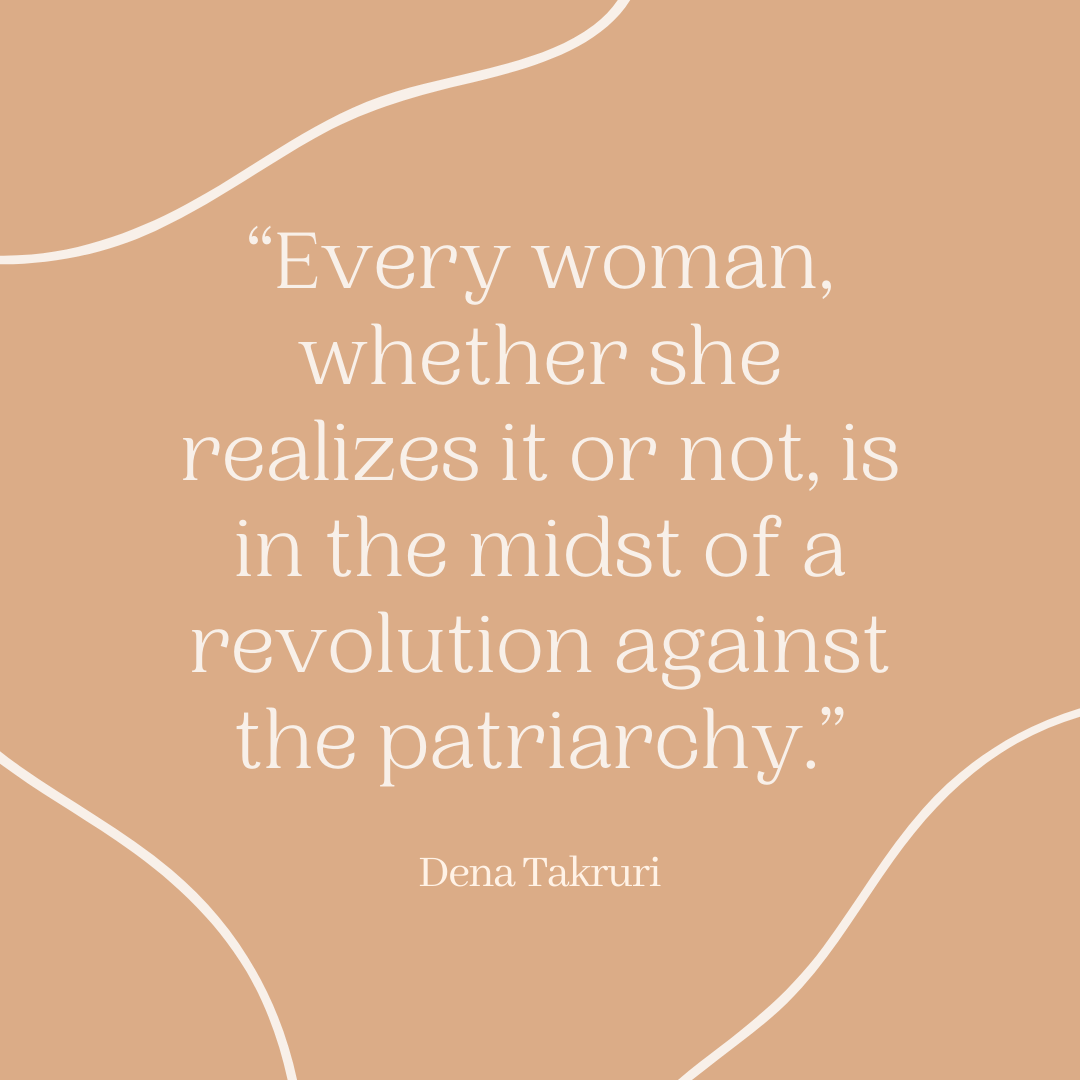
Dena Takruri Quote

What about your journey as a journalist do you feel most proud of?

I’m most proud to serve as a role model to younger women and girls from my community. It’s very humbling to hear them say that I’ve inspired them to speak out, or be brave enough to follow their dreams, or embrace their (Palestinian/Arab/Muslim) identity, especially as I remember how isolating it felt to grow up with virtually no role models who looked like me. One of the most touching moments I experienced was after I gave a speech at a Muslim American gala event. A college student came up to tell me that her father had been unsupportive of her desire to major in political science and was encouraging her to pursue something more “practical” like medicine and engineering instead. She said she played some of my videos for him, which changed his mind and made him get on board. I was really moved by that.

How does your identity of being Palestinian American influence the work you do and topics you cover?

I was born and raised in the U.S. but grew up visiting my relatives in the Occupied West Bank very regularly. The experiences of living under a military occupation with checkpoints, curfews, strip searches and the overall lack of freedom were transformative and shaped my political consciousness. Being Palestinian gives you a very personal and intimate understanding of injustice. I know what it means to be criminalized and dehumanized on the basis of your ethnicity and how it feels to be dispossessed from your land due to ongoing settler colonialism. It’s enabled me to connect the dots between the systems of oppression faced by other communities, whether we’re talking about Black Americans, Indigenous folks, or the undocumented. I’m driven to tell the stories of marginalized communities and people fighting for equality and self-determination and select my stories first and foremost through the lens of social justice.

What are forms of self-care you practice? 

I adopted a kitten two years ago and found that his companionship is very calming and healing and also brings me so much joy. I named him Shams, which is the Arabic word for sun and also the name of Rumi’s spiritual instructor and companion. My Shams has shown me that pet therapy is real! I also love riding my bike and dancing. Getting out of my head and into my body as much as possible is good for me as I tend to be anxious and overthink things. Reading and listening to audiobooks is another big self-care practice for me. And finally, knowing when to unplug from the news and social media is a form of self-care that I have yet to master but am steadily working on. It feels more imperative now than ever.

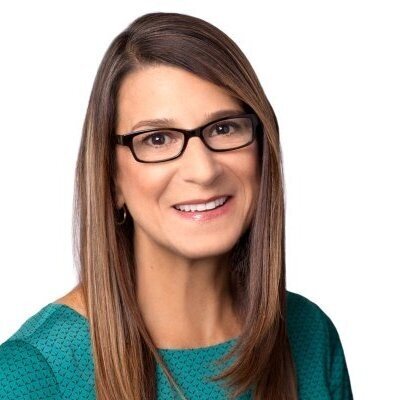
Dena Takruri, Journalist, Host and Producer. Photo by Tumay Aslay.

Dena Takruri, Journalist, Host and Producer. Photo by Tumay Aslay.

What advice do you have to give for young women wanting to use their voice for change but who are afraid?

You’re not alone. Patriarchy was designed to silence us, and that's exactly why we need to summon the courage to speak up and speak out. Every woman, whether she realizes it or not, is in the midst of a revolution against the patriarchy. It doesn’t matter whether she’s fighting for the right to vote, equal pay, autonomy over her body or the freedom to do or wear what she wants without getting catcalled, harassed or even worse. Every time a woman chooses to use her voice to stand up for herself, it benefits the rest of us. We’re living in a unique moment where we’re witnessing the power that social movements have to disrupt the status quo and aggressively push for gender, racial, and socioeconomic equality. These movements wouldn’t be around had women not used their voices to advocate for change.

That said, we must also be mindful of the fact that it’s inherently riskier for some women to speak up. Women of color, queer and transgender women, women who are less educated, and women of lower socioeconomic status are especially vulnerable. That’s why it’s incumbent on all of us, particularly those of us with more privilege, to support them with true allyship.

Twitter: @Dena
Instagram:
@denatakruri

Journalist Dena Takruri. Photo by Tumay Aslay.

Journalist Dena Takruri. Photo by Tumay Aslay.

A note from the interviewer.
Before I met Dena Takruri at an Arab Film Festival event, on whose board she was serving, I had watched many of her intelligent, captivating AJ+ viral videos on topics ranging from systemic oppression in the U.S. to the Israeli occupation in Palestine, read interviews with her online, and kept up with her Facebook page. Suffice to say, as an Arab woman myself, I was fascinated and inspired. The day I finally met her in real life, I almost fangirled her and asked for an autograph, until I remembered that I was also on the board of the Arab Film Festival, and we have friends in common who were present. Avoiding embarrassment, I went up to her and asked awkwardly for her name, trying to play it cool.

With time, and later a pandemic lockdown, we have become friends and I have gotten the privilege to know Dena Takruri behind the cameras and away from the noise of reporting zones. I got to see her deep care for the causes she reports on. I saw her attention to detail in everything she takes on. I saw her endless curiosity about humans, their stories, what drives them and even how could she help them. I witnessed her undying loyalty to her friends, family, community and her Palestinian roots. Dena's identities of journalist, activist, American, Palestinian, woman and human all are integrated and aligned around her core values. The Dena in front of the camera is the same as Dena behind the camera. She is the real deal. She is the authentic deal. And I am excited for you to get to know her too. 

Jessica Semaan

Jessica Semaan

Jessica Semaan is a freelance writer, book author, poet and performer. Chronicling her journey of healing from trauma, she has over 50,000 people following her writing on Medium. Jessica’s debut book Child of the Moon was published in 2018. She also is studying to become a psychotherapist.

The views, practices, information and opinions expressed in this article are those of the individuals involved in the article and do not necessarily represent those of Seismic Sisters.


Catching up with DJ heyLove* on Making Art in the time of COVID-19

By Polina Smith

COVID-19 is impacting all types of artists. It’s forcing them to get creative, get online, get on video, and reconnect with their family and friends in whatever ways they can. Seismic Sisters recently caught up with DJ heyLove* to find out how she is using Buddhist principles as she continues to be a DJ, artist, teacher, and mother during this time. 

 
DJ heyLove* spinning at inaugural ‘She the People’ summit held in the Julia Morgan Ballroom, San Francisco. Photo by Tumay Aslay

DJ heyLove* spinning at inaugural ‘She the People’ summit held in the Julia Morgan Ballroom, San Francisco. Photo by Tumay Aslay


What were you up to before the Coronavirus shut down live events in San Francisco? What kind of gigs did you have on the calendar?

DJ heyLove*: I had your ‘Seismic Power Shift’ conference, for one, which I was always really excited about! For Thousand Currents, a nonprofit that does work globally, I was supposed to do an event in June. And then wedding time was coming up. All of them have been postponed right now. I had a few corporate events, too. And then, of course, I have my residency at the Virgin Hotel three or four times a month. I also have a residency at Charmaine’s, which is a rooftop bar on top of the Proper Hotel in the city. I even had a kid’s party that was supposed to be in the city!

You had so much work lined up, yet you seem to be in bright spirits. I’m curious how have you been navigating this time?

I was a full-time DJ. I lost all my work. I had a couple of side jobs that I was doing at the time. I’m a trainer at a kickboxing gym and I also teach DJ lessons at Guitar Center. So those are my two little side jobs. But, I lost those as well because of Coronavirus business impacts. So I’m basically jobless. 

That’s definitely a hardship that hit home. Luckily, I saved a little for a rainy day. My husband is a full-time photographer. He is doing his ‘Shelter and Love’ social distancing photo project, which has been bringing some income because people have been giving him donations.

Not having Angel, my eight-year-old, in school has definitely been a challenge. He has two other brothers, but they don’t live with us at the moment. So he has no siblings to play with. I took on the role of mommy, play buddy and teacher. So that was a struggle for the first few weeks. We’re finally getting into the rhythm of doing schoolwork at home. That was difficult for a minute - to stay sane through it all - and I miss my family. I miss my friends and most everybody that I work with. Just that alone is also a struggle — to not be in the community. 

But I’m still in good spirits and I credit that to my Buddhist practice. We have our prayers and chanting. That has been helping me a lot — the spiritual meditation. It’s also about taking action. And if you’re not using your whole being and taking action to contribute to our created value, then you’re not really living to your highest potential. And that’s the whole point of a living being, a human being.

People have stressors inside, and they take it out in their home, environment, and things like that. But in order to keep the family harmony, you have to realize what’s real. And what’s real is that we’re alive, right? And that we’re well. That we’re together with one another. I pray for time with my family because I never really had enough time for my family. I was so busy working. And now I have it. So there are blessings everywhere.

There’s always something to be grateful for. My practice of having gratitude every day for being here has gotten me through these tough times. 

If you’re not okay inside, you can’t be there for anybody else. I really feel like it’s important that we all find a way to keep it together inside so that we can keep it together outside. I have a little home gym on my deck, and I’ve been making sure to work out at least three times a week. 

But I am so itching to DJ right now, I need to get into my music! Like I said, my spiritual practice has helped me remain happy inside. I’ve definitely been praying for the opportunity to hopefully bring some light to people and to DJ - I think that’s also going to help my spirit a lot.

 
DJ heyLove* spinning at a nightclub in San Francisco. Photo source: DJ heyLove*

DJ heyLove* spinning at a nightclub in San Francisco. Photo source: DJ heyLove*


What role can the artist play? 

This is going to be the time for artists to really shine through digital media. I’ve been seeing so many dancers, producers, vocalists, and DJs going live online, and it’s been awesome. The role of artists is to continue to remain creative and contributing beauty, keeping up that energy and positivity. Even if we can’t do it directly, at least we can do it live somehow on social media. It’s important for us to keep expressing ourselves and to keep wanting to give that to people.

Recently, I have become a Content Creator & Official Partner for TikTok’s Creative Learning Fund, which encourages education during the COVID-19 pandemic. From July 1st - August 31st I will produce 40 videos. People can follow me on TikTok @glowinglotus where I will post a series dedicated to sharing ‘Ways to Light Up Your Life’ with the purpose of keeping you “ALL GLOWED UP”! I’ve also created a brand new IG account where people can follow me @stillglowinglotus, where I hope to inspire and encourage you to elevate your life force. I’m also providing LIVE streaming DJ entertainment services for online gatherings, jumping on this trend.

Some people are sheltered by themselves and don’t have family that they live with or a roommate. It brings light and human connection when there’s somebody dancing or performing or playing music online. You can still feel that energy when people are doing it. Artists are here to bring life and light and beauty. It’s very important that we keep doing it because right now can be really dark. I think all of us have artists in us. This is the time to awaken the artist inside of us!

That’s so beautiful!

Of course, like my husband with his photo project — this is history happening to people right now, not just documenting what’s on the news, but documenting the people. Just everyday people who are also being affected somehow by this pandemic.

What would your message be to young artists right now?

Keep creating because if you’re creating your art form, you’re creating more than just art. You’re creating some sort of emotion. You’re creating freedom. You’re creating hope. You’re creating beauty. You’re creating love. 

The youth are what’s going to change the world. There’s some youth out there that are going to find some way to be reliable and revolutionary with their art forms and to really teach us as older people or teach the younger generation after them what is most important in life. We could get lost in everyday tasks and duties and our jobs and paying bills and all that, but art gives us a moment to stop and really reflect. For the youth, the art form needs to turn into something that’s revolutionary. That is going to change our way of thinking and the way the world is right now.

It’s really up to them because I think that COVID is teaching us a whole lot of things that I don’t think our world would see unless this happened. I truly believe that everything has profound meaning. This pandemic is showing us that we are all connected. One person can impact the world in a positive way. I feel like the youth right now - experiencing this at their age - hopefully, they will be able to create their art form to express a revolution of thought.

Stay up-to-date with DJ heyLove*:

Website: www.djheylove.com
Soundcloud: www.soundcloud.com/heylove-1
IG: @djheylove and @stillglowinglotus
Twitter: @djheylove
FB: www.facebook.com/djheylove/
TikTok: @glowinglotus

This interview was lightly edited for clarity.

Polina Smith is the Executive Director of Crescent Moon Theater Productions creating original, thought provoking new work that spans across the disciplines of theater, dance, music and circus. She holds a Master of Fine Arts in Creative Inquiry from the California Institute of Integral Studies. Smith is an art event producer for Bioneers and Seismic Sisters.

Reclaiming My Time: How to Identify Your ‘Professional Why’ for Your Lifestyle

By Alexandria Noel Butler

I have spent my whole career in the tech industry and so far, my career has been based on my ability to work on someone else’s dream and not my own. I have always been a small piece to a larger elaborate tapestry that has an original architect. Now this is not necessarily a bad place to be: I enjoy being a piece of thread to a great idea and I find power in working on cross functional teams to spin hay into gold. But this journey hasn’t been without its battles. I’ve navigated through a myriad of highs, lows, bad decisions, better decisions, thinking out loud and pretending to know what is going on. In order to keep my sanity, I have to always remind myself of what I am getting out of the tapestry. Why am I here? 

Five years ago, I had a conversation with my therapist about why I was at a particular job doing a specific role that was not fulfilling me completely. I told her that I needed to make money to exist and her response was striking, “You can make money at another place that fulfills you more than this.” It was the first time someone had given me permission to be intentionally selfish. I started to think: What drives me to succeed in my job? What pushes me to do my best work even when I disagree with the direction of the plan? What motivates me to continue spinning when I do not feel supported or appreciated by management? I left her large purple couch with a whole new outlook and promised myself that I would always seek my professional why. I realized, the more I know about me, specifically what I value and how I want to live my life, the easier it is for me to find career opportunities that cater to my actual wants and needs.

Alexandria Noel Butler, Founder of Sista Circle: Black Women in Tech and Unfiltered By Lexi B.  Photo source: Lexi B

Alexandria Noel Butler, Founder of Sista Circle: Black Women in Tech and Unfiltered By Lexi B.
Photo source: Lexi B

When you define your ‘professional why’ you begin to unlock your shackles to the opinions of others in regard to your career choices. Your professional why will come from four major categories, each one fulfilling a part of survival, thrift or joy. You choose a category based on your personal life and values. You should map a plan of action based on the specific category. It is quite simple when you think about it. Your professional why is your intentionality behind why you are working where you are working and the amount of stress and tension you are willing to deal with. As you create your personal why, here are the categories to consider. 

Coinage: Money makes the world go ‘round

We all are influenced by money to a certain extent but I can count on one hand the number of people who are truly and solely influenced by the dollar. Despite what capitalism tries to tell us, we all value money differently. The average person wants enough money to fuel their happiness - family commitments, hobbies, shopping habits, savings - the list is endless. But when you make the money that pays for your definition of a comfortable lifestyle, you don’t go searching for more coins. Professionally, there are many times when someone embarks on a new opportunity because of a larger paycheck. But the promise of a paycheck will only take you so far in times of stress and work tension. Your financial why cannot just be more money. The increase in salary needs to be attached to a personal goal. Paying off your student loans, a certain amount of money in your savings, savings for a large purchase such as a home, preparing for a new addition to the family. These are all personal reasons that have a large financial price tag. These reasons are what will keep you calm and collected in times of stress and uncertainty at work until you reach your milestone. 

Benefits: Non-Financial Perks That Smooth Out Your Life

In a full-time position, you will often find other powerful benefits that are not just your regular health care stipend, such as free or heavily discounted mental health benefits, opportunities to travel to different places, childcare stipends, and parental leave for up to six months. Depending where you are in your life, these benefits could support you tremendously. While you may be able to make more money someplace else, these benefits might keep you in your current role longer because they support your current personal goals. 

New Skills: The Lessons You Don’t Want To Learn But Know You Need

A new job can come with an opportunity to learn new skills. It is important to take inventory of the skills you have acquired in your career and the skills that you want to obtain. The best way to get these new skills is not a class or another certificate. It is to shadow someone who is great at that skill or be pushed off the diving board; therefore being required to learn as you go. You may find yourself in a situation where the job is offering you an opportunity. If you want to jump, just do it. Know that there will be times when you mess up or finish last. But be prepared to work very hard to become a master at this new skill. This new skill could offer you a promotion in pay and higher ranking job title. 

Breathing Room: #TeamTimeOut

I am in full support of #TeamTimeOut. It is a bench that you place yourself and opt into. It is a time when you are working to keep your lifestyle running without adding any extra stress or pressure. Life can be gruesome, especially for women of color. Sometimes you need a break from the long workdays and the pressure we receive from management and ourselves. #TeamTimeOut will not erase the microaggressions that we face. Those are systemic and date back about six centuries before us. But this time will give you the clarity to decide what is next. Also, #TeamTimeOut is a great opportunity to build your own tapestry while making enough money to support your lifestyle. Many famous world leaders, regardless of gender or color, have benched themselves in order to build their next great idea. To do this, you need mental and emotional bandwidth to prioritize your dream while doing your day job efficiently. You look at your current job as a clock-in/clock-out system. Go to work, do the job, come home. Do not bring the job home because your home is a place where the new dream is being cultivated. Do not worry about getting a perfect score on your annual review. You focus on getting an average score that keeps your finances exactly where you need them. 

Identifying your ‘professional why’ is one of the most important parts of your career journey. Your ‘why’ builds the foundation and mapping of your short-term goals. It is your guiding light as you decide what work battles to fight, what office politics to play and what type of leadership you value. The beauty of your professional why is that it can change at any time. The key is to always check in with your ‘why’. Is it still the same as it was when you started this new opportunity? Does it need to be changed? Have you changed? The continuous conversation surrounding your why will ultimately give you more peace in your professional and personal life and also push you to greater success. At the end of the day, you decide what success looks like for you. 

Your career is your job to manage. The questions are the following: Why are you doing what you are doing? What’s in it for you? How is this company, organization or manager helping you build your dream lifestyle? 


22688883_10210380432449249_3013317509559968200_n.jpg

Alexandria Noel Butler - ‘Lexi B’ - is a Senior Program Manager in the technology industry and the founder of Unfiltered By Lexi B, a lifestyle social media account giving career advice to young professionals. In 2017, she founded Sista Circle: Black Women in Tech. She holds a dual degree from Stanford University in Communications and Spanish. 

Activist and Media Maker Alice Wong Brings Us Moving Stories by Disabled Writers

By Karen Gullo

Touring the Deep South, a young Muslim woman visits Elvis Presley’s birthplace on a hot, humid day in Mississippi. The visit happens to occur during Ramadan and normally she strictly abstains from food and water until sundown (though she’s not required because she has a disability). But there was something about being in Elvis’ place that made it OK to break the fast. “I did not want to die where Elvis was born,” she explains.

A Black woman in the Midwest takes a job running an organization that helps disabled people live independently, despite warnings from friends that the place was a “lost cause.” She remembers being called a “lost cause” because of her autism, and struggled for years to hold down a job. But she rejects the warning and goes to work, turns the organization around, decides to run for state office, and is elected to the board of a national nonprofit, the first disabled person to hold an executive position there. “Lost cause, indeed,” she says.

These are snippets from just two of the intensely personal contemporary narratives in Disability Visibility: First-Person Stories From The 21st Century, an anthology compiled and edited by disability activist, media maker, and consultant Alice Wong. Raw, compelling, funny, and always deeply moving, the stories reveal struggles and triumphs of 37 writers and activists with disabilities who grapple with living everyday lives in an ableist society that often sees them as different and flawed.

Alice Wong - Disability activist, media maker, and editor of “Disability Visibility: First-Person Stories From The 21st Century.” Photo credit: Eddie Hernandez Photography

Alice Wong - Disability activist, media maker, and editor of “Disability Visibility: First-Person Stories From The 21st Century.” Photo credit: Eddie Hernandez Photography

It’s a struggle familiar to Wong, whose drive and belief in herself and her community has made her a leading voice advocating for disabled people in culture, society, politics, and literature.

“Staying alive is a lot of work for a disabled person in an ableist society, and that work has been a big part of my forty-six years on this planet,” Wong says in the book’s introduction.

Wong is the founder of the Disability Visibility Project in San Francisco, an online community about disability media and culture. No coincidence that the organization, which she runs herself, is also the name of the new book, illustrating the deep connection between the book’s celebration of the voices of writers who are disabled and Wong’s experience.

Born in a suburb of Indianapolis to Hong Kong immigrants, Wong has a neuromuscular disease that results in muscles weakening over time. She gets around in a powered wheel chair, and is dependent on a ventilator to breath and attendants to assist in everyday tasks like eating, dressing, and bathing.

As she told Vox in April, people are freaking out about health risks during the COVID-19 pandemic, but she and other disabled people have been living all their lives with uncertainty and have experience adapting to a health crisis—they’ve always had to adapt because the world “was never designed for us in the first place.”

She started Disability Visibility in 2000 as a one-year oral history campaign in partnership with Story Corp. It’s grown into an online community on disability media and culture, broadcasting podcasts, interviews and radio stories, hosting Twitter chats, and publishing essays about ableism and politics from the perspective of disabled people.

Wong’s advocacy for the rights of the disabled has been recognized by Time magazine, which this year named her as one of 16 people fighting for equality in America, and by Bitch Media, which named her one of 2018’s top 50 impactful activists in pop culture. In 2015 Wong was invited to the White House by President Obama for a celebration of the 25th anniversary of the Americans With Disability Act (ADA). She could not attend in person. Instead, she met the president using a telepresence robot, whose movements she controlled via her computer at home while her face and voice were projected on the robot’s “head”—a computer screen.

Wong has been speaking out frankly, and angrily, about COVID-19 and policy conversations about who deserves care as the pandemic spreads and creates competition for ventilators, masks, and hospital beds. Early in the pandemic, some states were drafting care guidelines that could lead to people with autism and other intellectual disabilities being denied access to lifesaving care.

Doctors treating COVID patients might look at the health history of a disabled person and decide that others with a better shot at survival are more worthy of getting a ventilator, Wong posits.

“I am angry seeing so many people outdoors not wearing masks or social distancing,” she said in a telephone interview. “They are going to create more infections, and more deaths,” and make it more difficult for high risk people to stay safe.

Disability Visibility, published by Vintage Books, an imprint of Knopf Doubleday Publishing Group, was released June 30 in time for the thirtieth anniversary of the ADA. “These stories do not seek to explain the meaning of disability or to inspire or elicit empathy,” Wong says in the book’s introduction. “Rather, they show disabled people simply being in our own words, by our own accounts.”

“Disability Visibility: First-Person Stories From The 21st Century” edited by Alice Wong and released in 2020. Book cover by Madeline Partner.

“Disability Visibility: First-Person Stories From The 21st Century” edited by Alice Wong and released in 2020. Book cover by Madeline Partner.

The book features essays, blog posts, Congressional testimony, and eulogies by writers who have very unique but also interconnected takes on life as disabled people in the U.S. Anna Kaufman, who edited the book for Vintage, calls the book an “urgent, vital call to arms.”

“These stories show how diverse the disabled community is, and that so many of the issues at hand are astoundingly intersectional -- there's something for everyone, and that affects everyone,” Kaufman said by email.

Contributors include Jeremy Woody, who was incarcerated in a Georgia state prison, and writes of the discrimination he experienced as a deaf prisoner in a system that offered no accommodations. “Prison is a dangerous place,” he writes, “but that’s especially important for deaf folks.”

Standup comic, actress, and activist Maysoon Zayid, in “If You Can’t Fast, Give,” says her cerebral palsy, which makes her shake “like Shakira’s hips,” finally forced her to stop fasting during Ramadan, a practice she misses dearly. Fasting is important, she says, but “it’s important not to die in the process.”

“I have participated in several other projects that highlight disabled voices, but the editors and decision makers did not identify as disabled and the compilation suffered because of it,” said Zayid in an email. “This anthology really does our community justice and serves as a great resource to our non-disabled audience so that we can stop educating them on Twitter.”

Throughout the book, contributors talk about being made to feel like they are people who are broken, in need of fixing, people who should be seeking a cure, a new medicine or therapy that will make them able. Through struggle and with courage, they write of rejecting the boxes they are put in and realizing that the mindset that identifies disabled people as broken is itself a sign of a society’s lazy disinterest in seeing them as people who are simply part of a world of diverse human beings.

“I felt like a piece of clockwork waiting to be fixed,” writes June Eric-Udorie, a journalist and activist who writes in the anthology about her life as a young woman of color living in London. Eric-Udorie was born with a congenital condition that causes her eyes to move involuntarily and partial blindness. Attending church at 15, her grandmother tells her to put the communion hosts soaked in wine on her eyes so that she can be cured. She was brought to many doctors, none able to cure her.

Nearing adulthood, Eric-Udorie writes, she goes by herself on a trip to Bath to see if she can overcome a fear of being independent, and “move through the world on my own terms.” Nothing bad happened on the trip. “I felt like a winner” sitting at a café on her own, she writes. Later, in London, she still attends church, not as someone “with a heart that is begging for the most special part of me to change,” she writes. “I come to church free. I come to church knowing that I am not a mistake waiting to be fixed.”

0.jpg

Karen Gullo is a freelance writer and former Associated Press and Bloomberg News reporter covering technology, law, and public policy. She is currently an analyst and senior media relations specialist at Electronic Frontier Foundation (EFF) in San Francisco.

BLM Letter from the Heart – Activist Kaylah Williams on Black Lives Matter Protests in San Francisco

By Kaylah Williams

I was born and raised in Shreveport, Louisiana where the Black population is over 50 percent, but all the schools and neighborhoods are still segregated. I went to predominantly white public schools, and from a young age I learned to carry my blackness with pride even if I was the only Black girl in the room. The racism I faced growing up ranged from small microaggressions, “You talk so well for a Black girl” to more outright racism, “I just don’t feel comfortable having you handle those files, so I gave them to Rebecca.” After I graduated university, all I wanted was to leave the South and move to California.

Black Lives Matter protest in front of Mission High School in San Francisco on June 3, 2020. Photo by Tumay Aslay.

Black Lives Matter protest in front of Mission High School in San Francisco on June 3, 2020. Photo by Tumay Aslay.

It seems so foolish to even say out loud, but I really thought that moving away would mean I wouldn’t have to face overt racism again. But racism doesn’t just go away when you move. The systemic problems facing this nation are so insidious. The systemic inequities of San Francisco are just the same as Shreveport. Fewer Black communities just makes it easier for Black voices to be completely left out. I found my calling in fighting for the unheard Black voices of San Francisco through my political work. And it continues to give me strength even when I feel lost or alone in this city.

‘Enough!’ hand-painted sign at protest in Mission District on June 3, 2020. Photo by Tumay Aslay.

‘Enough!’ hand-painted sign at protest in Mission District on June 3, 2020. Photo by Tumay Aslay.

It took a long time for me to find the strength to watch the whole video of George Floyd’s killing. After I watched it, I laid in bed paralyzed with fear, anger and a profound sadness. I stayed in bed. I cried for George Floyd and the future that was robbed from him. I cried for my father who had a gun pulled on him only because he shared the same first name and skin color of someone else’s warrant. I cried for my brothers who were treated poorly by white elementary school teachers because little black boys are “aggressive” while white boys are just “rambunctious.” I cried for myself who had the police called on me on Election Day 2016 for being a suspicious person in the neighborhood when my only crime was campaigning while Black.

It finally feels like America is seeing the world the way that I’ve always seen it — America the free, for some. It’s like a light switch has been turned on. For the first time in most of our lives there is national attention on racial inequality and police brutality. Protests have happened in all 50 states and around the world. George Floyd’s daughter said, “Daddy changed the world” and she’s right. His killing feels like the catalyst to finally say, enough is enough. Now is the time to take to the streets. So I did.

In the blazing sun I marched alongside thousands of San Franciscans. I felt the power of my own voice rising from deep inside. I shouted “No Justice? No Peace!” echoed by voices behind me. Soon I was surrounded by chants in unison. I shouted so loud I felt tears swelling in my eyes. My mind could only hold focus on the families of Ahmaud Arbery, Breonna Taylor, and George Floyd. I zoom forward in my own history and think of my future children. When will the senseless killing of my people and my community end? By then I had tears running down my cheeks as I shouted again, “No Justice? No Peace!” After a few more rounds of chants I needed to rest my voice. In that brief moment of pause I was faced with a beautiful act of solidarity. Someone a couple of feet back picked up the chant, “No Justice? No Peace!” The chant grew louder and louder as far back into the crowd as I could see. This is the change America needed. This is just the beginning of a fight we will all join in. Change is coming.

It’s hard to be a Black woman in America. Our voices are tired of screaming for justice alone, but now finally it feels like we’re not fighting alone. There is a movement growing bigger and bigger every day. One protest does not change the world, but every protest, every rally, every conversation moves us closer. As Assata Shakur said, “Dreams and reality are opposites. Action synthesizes them.”

Young Black Lives Matter protesters in Mission District of San Francisco on June 3, 2020. Photo by Tumay Aslay.

Young Black Lives Matter protesters in Mission District of San Francisco on June 3, 2020. Photo by Tumay Aslay.


Kaylah-Paige-Williams_-7.jpg

Kaylah Williams is a social justice activist and political campaign manager in San Francisco, California. Williams founded the San Francisco chapter of AfroSocialists and Socialists of Color Caucus. She is also on the executive board of the Harvey Milk LGBTQ Democratic Club.

Black Lives Matter Protests in San Francisco - Demanding Change and Creating a New American Culture

By Kim Christensen, Editor of Seismic Sisters

No matter how bad the news gets, I look to the power and potential of this sisterhood to grab the opportunity to change the culture, redesign our society and create something better. This week exposed so much of the ugliness that exists in American culture. It showed the toxic legacy of slavery is still visibly with us, wholly unresolved and causing harm on a daily basis. Black people are still being killed by police – George Floyd in Minneapolis and Breonna Taylor in Louisville, an EMT shot in her own home by police in a midnight raid. Breonna Taylor was an aspiring nurse and is now the latest to join the tragic list of Black women whose unjust death is being spotlighted by the #SayHerName campaign.

Marchers at Justice for George Floyd and Black Lives Matter march in San Francisco on May 31, 2020 Photo by Tumay Aslay

Marchers at Justice for George Floyd and Black Lives Matter march in San Francisco on May 31, 2020
Photo by Tumay Aslay

The legacy of slavery is also what’s causing African-Americans to die from COVID-19 in higher numbers. And now we’re all getting familiar with the phenomenon of ‘Karening’ and how that can have deadly consequences or lead to the arrest of Black people – or in some rare cases for Karen to lose her job. #BlackLivesMatter has done so much work to educate white people about the reality of American culture, its deadly impacts, and how it has stolen opportunities, health and wealth from Black people.

Marchers at Justice for George Floyd and Black Lives Matter march in San Francisco on May 31, 2020. Photo by Tumay Aslay

Marchers at Justice for George Floyd and Black Lives Matter march in San Francisco on May 31, 2020. Photo by Tumay Aslay

Now it’s time for white people to ACT and change things. White people have a moral responsibility to learn about ‘white privilege’ and begin now to support local Black-led community organizations. As Kim Crayton says, white people. . .“We need you to not wait around looking for orders but to actively engage by asking ‘how can I help?’, ‘where do you need me?’, ‘who can I connect you to?’, and ‘how can I fund this?’ to name a few. ” 

We can take action TODAY! I just donated to one of my favorite local groups, Community Awareness Resources Entity, which is providing food deliveries and support to isolated seniors and families in public housing. Other Black-led grassroots organizations in the Bay Area you might consider funding include: Black Futures Lab or She The People.

Marchers at Justice for George Floyd and Black Lives Matter march in San Francisco on May 31, 2020. Photo by Tumay Aslay

Marchers at Justice for George Floyd and Black Lives Matter march in San Francisco on May 31, 2020. Photo by Tumay Aslay

Educating ourselves about the issues and what we can do is key.
Some helpful teachers and books include:

Confronting the damage caused by white supremacy and repairing our culture and institutions is the work we need to be doing right now. Fortunately, the crises we are in right now mean that we can solve many problems at once and create a joyful loving healthy future. A ‘Beloved Community’ as Dr. Martin Luther King, Jr. called it -- that is what we have the opportunity to create.

Periods Optional? Yes, Says Female Founder of Birth Control Delivery Service Pandia Health

By Karen Gullo

We’ve all been there. And it’s not fun.

You’re about to give a major presentation, or sitting on pins and needles before taking an important exam, or seeing your kids off to camp for the first time, and bam! You get your period.  Or it’s the night before you leave on vacation when you suddenly realize you forgot to run by the drug store to pick up birth control pills.

Such are the trials of womanhood. Women in the U.S. begin having their periods at 12 years of age on average, and have monthly periods (except during pregnancy and breast feeding) 12 times a year until menopause, which occurs, on average, around age 51. For someone who has two kids and breast feeds a few months for each, that adds up to about 440 periods. That’s a lot of bleeding, and a lot of trips to the drug store. And for some women it means monthly cramps, fatigue, depression, and mood swings.

Photo by nensuria/iStock / Getty Images

Photo by nensuria/iStock / Getty Images

The Curse. Aunt Flo. It’s just part of what we have to put up with as women.

Or is it?

Dr. Sophia Yen, CEO and co-founder of the doctor-led birth control delivery service Pandia Health, says no. Unless you’re trying to get pregnant, periods are optional, she says. Fewer periods, and birth control pills delivered to your door, would make life a lot easier for millions of women.

“If we don’t want to get pregnant, why the hell are we bleeding so much?” Yen asks in an authoritative and incredulous voice that has you asking yourself: yea, why the hell are we bleeding so much?

Yen began thinking seriously about this back in the mid 2000s. An adolescent medicine specialist and expert in reproductive health, Yen has been studying, teaching, and counseling patients about menstrual health for two decades. At Physicians for Reproductive Health, a New York-based organization focused on improving women’s access to comprehensive reproductive healthcare, Yen was on the faculty of its Adolescent Reproductive Health Education Project for more than a decade. A graduate of MIT, UCSF School of Medicine, and UC Berkeley School of Public Health, Yen teaches and speaks frequently to physicians, educators, and young women about menstruation, birth control, emergency contraception, and pregnancy prevention. In addition to running Pandia Health, Dr. Yen is a Clinical Associate Professor at Stanford Medical School, where she’s worked for over 17 years.

Dr. Sophia Yen, CEO and co-founder of the doctor-led birth control delivery service Pandia Health.  Photo source: Sophia Yen

Dr. Sophia Yen, CEO and co-founder of the doctor-led birth control delivery service Pandia Health.
Photo source: Sophia Yen

It was during a talk to a group of doctors that she was asked why women miss taking their birth control pills. Researchers estimate that as many as 40 percent of oral contraceptive pill users don’t keep up with the daily pill-taking regimen, partly because of the inconvenience of having to make frequent visits to the drug store for refills. Women have busy lives, Yen told the doctors.

“You’re chained to the pharmacy, you’re freaking out about getting your prescription filled,” she said. “It’s another micro-aggression stressor in women’s lives.”

Pandia Health delivers birth control pills by mail. Photo source: Sophia Yen

Pandia Health delivers birth control pills by mail.
Photo source: Sophia Yen

It was a desire to make women’s lives easier, and give them the opportunity to break free of monthly periods, that led Yen to start Pandia Health in 2016 with friend and entrepreneur Perla Ni. Pandia, based in Sunnyvale, California, is an online telemedicine service where women can get birth control pills, whether or not they have insurance, delivered to their home by mail. No trips to the pharmacy, and for most women, there’s no trip to the doctor required.

Pandia is unique among birth control home delivery services in that it was founded by women, run by women, and led by female doctors. Yen raised money from her family and friends to launch the service, and later raised $2 million from investors through startup accelerators Springboard Enterprises, StartX, and Women’s Startup Lab. The elevator pitch for Pandia Health was: telemedicine meets Amazon Prime for birth control or the Dollar Shave Club for Women but with birth control. 

The service is fairly simple. Women without a prescription fill out an online questionnaire about their general health and menstrual history and provide a blood pressure measurement from the past year. This is examined by one of Pandia’s six female doctors. The customer pays $20 for this. If everything looks good, you get a prescription, which is filled by Pandia Health’s partner pharmacies. Patients without insurance pay about $20 a month for one pack of birth control pills, or $15 each for a three-pack. Pandia Health can currently provide online doctor visits for customers needing new prescriptions in California, Florida and Texas. It can deliver to all 50 states, so if you already have a prescription, Pandia can move it from your current pharmacy to theirs and provide free delivery with automatic refills and some goodies like Hi-Chew, tea, and chocolate.

Pandia Health operates a nonprofit, the Pandia Health Birth Control Fund, which provides financial assistance to patients who need it for the doctor screening, the medication, or both.

Those with insurance and an existing prescription fill out the questionnaire, provide a blood pressure test, a copy of a government ID, and a selfie. Pandia bills the patient’s insurance, and makes money from the difference between the reimbursement and the price it pays to source the birth control pills.

Patients have absolute control over the frequency of their periods—they can have a period every month, every three months, every six months, or even once a year. This is accomplished by skipping the week of placebo sugar pills, or the ring-free week if you’re using a birth control ring, and just go right onto the next pack or ring. The primary side effect is spotting.

Typical use of birth control pills includes a week of taking placebo pills, which reduces hormones in the body, causing menstrual bleeding. Birth control pill inventor Dr. John Rock, a devout Catholic, designed the contraceptive that way—some say he wanted the pill, which was approved by the FDA in 1960, to be seen as a better way to practice the “rhythm method.” That was the only form of contraception approved by the Catholic Church, and Rock was seeking the Vatican’s approval for his invention (he lost that battle).

About a quarter of Pandia’s customers skip their periods. Dr. Yen and other reproductive health experts say that for most women it’s safe; period cessation slightly increases the risk of breast cancer, but lowers the risk of anemia, ovarian cancer, endometrial cancer, and colorectal cancer, and helps those with endometriosis and ovarian cysts.

Erin Macguire, a 20-year-old college student in Los Gatos, California, heard about Pandia from a friend. She’s been taking birth control pills since around age 15, when her doctor prescribed them to control frequent heavy periods that had caused her to become anemic. She started using Pandia last September and has opted for having periods every three to four months.

“It’s so easy and it saves money,” Macguire says. “If I don’t have to have periods, why do it?”

The average women spends between $150 to $300 a year on feminine hygiene products. Because tampons and panty liners aren’t considered a necessity, like medical devices or food (or Viagra—untaxed as a prescription drug), they are subject to state taxes, aka the “tampon tax.” California passed a law last year to end the tampon tax, but only for two years

Kelsey Ricketts, another Pandia customer, uses a specific type of birth control pill that not all pharmacies carry. She looked online and contacted Pandia, which said it could supply the pill she needed. An office manager at a chiropractic office in El Dorado Hills, California, Ricketts, 27, doesn’t have health insurance, and said the physician screening process at Pandia was much easier than trying to get a doctor’s appointment. “It’s made a huge difference,” she said. “It’s all done through text messaging, and someone gets back to me within five to 10 minutes.”

Fewer periods can be life-changing in more ways than one. Not having to deal with cramps and mood swings every 28 days can help woman perform better in school and in the work force, Yen says. Studies show that one in five women miss school or university due to period pain. Two in five report that menstrual pain affected their concentration or performance in class. Yen says she’s seen teens in her clinic miss two days of school each month because of their periods—that’s 10 percent of their educational opportunities at a crucial time in their academic lives lost because of menstruation.

Yen remembers getting her period the day she had to take a biochemistry final as a pre-med student at MIT. “I am flipping out, and I’m looking to my left and right,” she says. Sitting next to her on both sides were male classmates—they’ll never have to deal with this, she thought.

“Now that I have two daughters, I don’t want them to be in the middle of a test, or a performance, or doing a sport and have to worry about blood trickling down their leg,” says Yen. “This is personal, for me and for my daughters.”


0.jpg

Karen Gullo is a freelance writer and former Associated Press and Bloomberg News reporter covering technology, law, and public policy. She is currently an analyst and senior media relations specialist at Electronic Frontier Foundation (EFF) in San Francisco.


Fighting Stigma of Psychedelics with Science - An Interview with Natalie Ginsberg, Policy and Advocacy Director at Multidisciplinary Association for Psychedelic Studies

By Jessica Semaan

After decades of being stigmatized, feared, and criminalized in the United States, psychedelics are getting a fresh look and being studied for their healing potential by scientific researchers and psychotherapists. With a growing interest in the use of psychedelics in medicine and as tools for healing trauma in guided psychotherapy contexts, we reached out to interview Natalie Ginsberg, Policy & Advocacy Director at the Multidisciplinary Association for Psychedelic Studies (MAPS), a “non-profit research and educational organization that develops medical, legal, and cultural contexts for people to benefit from the careful uses of psychedelics and marijuana.” Ginsberg shared her personal journey which brought her to work on this topic and ultimately to become a public face and advocate for MAPS.

Tell us about your path to becoming the Policy & Advocacy Director at MAPS, a job that I would imagine is highly coveted.

Natalie Ginsberg: While pursuing my master's degree in social work, I worked as a therapist with people arrested for prostitution at an alternative sentencing court, and I worked as a guidance counselor at a Bronx middle school located in one of the poorest zip codes in the United States. I noticed that so much of the trauma people were facing stemmed from oppressive policies and systems, especially related to mass incarceration and criminalization, and driven by racism and the profit-maximizing demands of capitalism. I was seeing firsthand how drug policy is used as a deeply racist tool and the largest driver of mass incarceration. During college, I had interned for the Brooklyn District Attorney’s office, and had to refuse to process the hundreds of cases that were coming in for black teenagers arrested for crumbs of marijuana, when my white classmates from Yale were smoking freely a few blocks away from the courthouse without a worry from the cops. My senior year in high school, a cop walked up to me smoking a bowl in a park and said, “Honey put that down, aren’t you going to college?” It was so clear that these thousands of marijuana arrests were not about the cannabis, but were an excuse to criminalize black people.

Natalie Ginsberg, Director of Policy and Advocacy at the Multidisciplinary Association for Psychedelic Studies. Photo by Tumay Aslay.

Natalie Ginsberg, Director of Policy and Advocacy at the Multidisciplinary Association for Psychedelic Studies. Photo by Tumay Aslay.

How did that lead you to MAPS?

I began a fellowship at the Drug Policy Alliance, where I was working on a campaign for marijuana decriminalization that focused on racially disparate arrests. After we succeeded in decriminalizing marijuana in New York State, I was moved to the medical cannabis campaign, and we also ended up legalizing medical cannabis in New York, though unfortunately Governor Cuomo personally removed the ability to smoke cannabis from the legislation, after the law had been passed by the legislature. While working at Drug Policy Alliance I started to read about MAPS, and their research struck a chord. Though I had enjoyed smoking cannabis, before my work on this campaign I never understood cannabis’ deep medical value. Now I was intrigued to read the research and learn that other plant medicines and psychedelics could help people struggling with addiction, PTSD, and depression — ailments I had learned had no cure in social work school.

What was the psychedelic therapy you read about?

Natalie+Ginsberg+Director+of+Policy+%26+Advocacy+MAPS.jpg

As a policy fellow at Drug Policy Alliance, I was asked to write an article about a MAPS LSD therapy study for the treatment of anxiety. I quickly discovered that the bulk of MAPS’ research was focused on MDMA-assisted therapy for the treatment of PTSD (post-traumatic stress disorder). Researchers and psychotherapists were finding that psychedelic therapy had the potential to heal or lessen a wide range of afflictions in only a few sessions. I figured psychedelic therapy must be addressing the root of the problem rather than suppressing the symptoms, which really resonated with me. I also understood that the research must have broader political implications regarding the way we approach medicine and treatment as a society. I reached out to the pioneering MDMA therapist Marcela Ot’alora after seeing her speak at a Drug Policy Alliance conference, and after a beautiful conversation with Marcela I connected with the founder Rick Doblin, who luckily needed some help on the marijuana-policy front.

You've been at MAPS for six years now. How have you seen the organization change?

Size-wise, we’ve more than doubled our team. In certain ways, the organization doesn't feel different internally, but things have changed significantly from the outside due in large part to the research that MAPS has done in the last 30 years.

What has changed from the outside?

Society has started to become more accepting of our work and MAPS’ goal of mainstreaming psychedelic medicine seems closer than ever to being achieved. The popularity of Michael Pollan’s book How to Change Your Mind, news coverage on the TV show “60 Minutes,” and other mainstream movements are helping to shift the tide. There are even ayahuasca jokes and MDMA-themed episodes on a bulk of mainstream TV shows these days! We are starting to see major policy shifts, such as the city of Denver decriminalizing psilocybin and the cities of Oakland and Santa Cruz decriminalizing all entheogenic plants.

Natalie Ginsberg, Director of Policy and Advocacy at MAPS. Photo by Tumay Aslay.

Natalie Ginsberg, Director of Policy and Advocacy at MAPS. Photo by Tumay Aslay.

What is something you are proud of in the past 6 years at MAPS?

A change I'm really proud of is our work toward more accessibility. Last summer we hosted our first MDMA therapy training for communities of color, which opened with a workshop called Psychedelic Medicine and Cultural Trauma. We're expanding our conversation around who has access to these medicines and where these medicines come from. The reality is that the highest rates of trauma exist within the communities that are most marginalized in our society, including communities of color and queer communities, and especially indigenous communities around the world, who are also the communities who have been in practice with plant medicine for millennia. A lot of marginalized communities don't have access to diagnosis or treatment. When trauma is constant it can be even more deeply traumatic, especially when it is compounded by the historical and intergenerational trauma that is often attached to social marginalization. It's important that we expand our understanding of PTSD, especially when considering who has access to psychedelic therapy and which therapists are best equipped to provide this sort of treatment to various populations.

You mentioned that you are working on the psychedelics in conflict resolution study. I'd like to hear more about it and share with our readers. It sounds very fascinating.

I’ve been working with Antwan Saca, a longtime Palestinian peace activist, and Dr. Leor Roseman, an Israeli psychedelic researcher at Imperial College in London, exploring how psychedelics might be useful in conflict resolution, peace building, and reconciliation between Palestinians and Israelis. We are curious to see if these contexts might be particularly helpful for healing shared intergenerational trauma. In our research, we started by interviewing 36 Jewish, Christian, and Muslim Israelis and Palestinians who had sat together in ayahuasca circles. Many of the participants reported powerful visions of historical trauma or flashbacks from time served in the military. One Palestinian man reported being in the body of an Israeli soldier and looking down the barrel of a gun aimed at a Palestinian man. Strikingly, this Palestinian man reported a noteworthy compassion for the Israeli soldier’s pain, saying “this is not an easy life after” pulling the trigger. He talks about how his activism changed tremendously after this experience, from being motivated by hatred, even in his nonviolence, to now being motivated by love and compassion, which he reports feels much healthier in his own body and mind. Multiple Jewish Israelis reported hearing Arabic sung during ceremony as one of the most impactful pieces of ceremony, as they were being able to release the fear and hatred they didn’t even realize they had associated so deeply with the Arabic language and Arab people — one Jewish woman describes how for the first time the language of Arabic was sending her “light and love.” I wrote an article about it titled “Can Psychedelics Play a Role in Making Peace and Healing Cycles of Trauma?” in the MAPS 2019 Winter Bulletin, and gave a talk presenting more of our research in Austin titled Can Ayahausca Promote Peace in the Middle East?

What does power mean to you as a woman?

I think a lot about what it means to be a woman in power and how to model feminine kinds of leadership in the context of our patriarchal society. One feminine approach to power that I employ is to work collaboratively, making sure that the power I have as a director is shared with others. I always include lots of perspectives and opinions in my decision-making, sometimes to a fault. Feminine power to me is about being reflective, listening to your body, listening to your intuition — the opposite of what our patriarchal society teaches us, which is to ‘power through’ and that your value comes from how hard you work. That's another big piece of feminine leadership that I'm trying to embody — operating from a place of what feels right and feels aligned in my body. If a masculine approach to leadership is more reactive and proactive, and a feminine one is more reflective and intentional, the most effective and healing modes of social change strike a balance between the two.

Is there something you find challenging as a female leader?

In my efforts to be more collaborative and build new ways of operating, I sometimes disempower myself. I always use the word “we” because I work with so many amazing people and we build together. I notice that so many men talk about their work using only the word “I.” But on the flip side, I can sometimes erase my individual contributions when I'm elevating others, so it's an interesting balance to strike. The reason I mention that is because the dynamic of men raising themselves up and women elevating others contributes to the issue of people not seeing women leaning into things.

Natalie Ginsberg in Los Angeles. Photo by Tumay Aslay.

Natalie Ginsberg in Los Angeles. Photo by Tumay Aslay.

Whether we like it or not, we operate within a patriarchal system. I wonder how not wanting to play into patriarchy might come at the cost of your contributions being taken into account.

I’m trying to model ways of living and working that are healthy, where I get enough sleep and eat well and take care of my mental health. In this hyper-masculine, hyper-competitive society we live in, I see people not sleeping, not eating, always being urgent. I understand that because our work is urgent, and people are dying and going to jail every day because they don't have access to therapeutic treatment. But I'm very inspired by thinkers like adrienne maree brown, who talks about how the best way of serving is to take care of ourselves so that we're best able to do our work for social change.

Do you have any self-care routines or tools that you could share?

I find yoga to be really powerful, not only yoga classes but the ability, wherever I am in the world, to feel into my body where I'm holding tension, and to stretch it out. Dancing also connects me to my body; it's very cathartic. I love to smoke a joint and dance to Beyoncé alone in front of my mirror. Smoking cannabis is very healing for me. It can be a really powerful, self-reflective, and therapeutic time for me where I process a lot. Quality time with friends, and spending time in spaces where you just feel nourished and inspired. Whatever feels good! Massages!

Any resources for people who are interested in learning more about psychedelics?

Absolutely. MAPS.org for information about studies, psychedelic harm reduction, and a wide variety of other documents related to psychedelic history and research. Cosmovisiones Ancestrales, co-founded by Paula Graciela Kahn, with the mission to “build bridges between indigenous communities, psychedelic researchers, mental-health professionals, drug policy makers, psychedelic consumers, and populations that have been acutely impacted by the legacies of colonialism, slavery, war, and forced migration.” Chacruna, founded by Beatriz Caiuby Labate, is another great resource for interesting articles about the social, cultural, and political contexts of different psychedelic plant medicines.


This interview has been lightly edited for clarity.

Jessica Semaan is a freelance writer, author, poet and performer living in San Francisco. Chronicling her journey of healing from trauma, she has over 50,000 people following her writing on Medium. Jessica’s debut book Child of the Moon was published in 2018. She also is studying to become a psychotherapist.

The views, practices, information and opinions expressed in this article are those of the individuals involved in the article and do not necessarily represent those of Seismic Sisters.

An Interview with Amber Julian and George “WuKong” Cheng from the Bay Area’s Legendary Embodiment Project

By Polina Smith

Embodiment Project is a San Francisco-based street dance theater company that “intersects hip hop, documentary theater, live song and choreo-poetry to illuminate narratives silenced by inequities and inspire critical conversations and healing.” But what happens when a thriving performing arts season suddenly comes to a halt? How do you pivot to using video conferencing and social media to communicate what is at your dance company’s very core? It has been challenging, make no mistake, but like with their art, Embodiment Project is handling it with resilience, creativity and grit. I caught up with dance company members Amber Julian and George “WuKong” Cheng to get their thoughts on the current situation for artists and what role art can play during the COVID-19 pandemic. 

Embodiment Project company members Dre Devis, Amber Julian, Nicole Klaymoon, Keisha Turner, Sammay Dizon, courtesy of Yerba Buena Center for the Arts.

Embodiment Project company members Dre Devis, Amber Julian, Nicole Klaymoon, Keisha Turner, Sammay Dizon, courtesy of Yerba Buena Center for the Arts.

Polina: What was Embodiment Project (EP) up to before the virus hit?

George: I think it was literally the night before the Bay Area called shelter-in-place, Amber, myself and Nicole were all together and EP was supposed to go to Akron, Ohio, for a one-week residency. We were in the lab working on our Yerba Buena Center for the Arts premiere of X RATED PLANET. We were pretty busy gearing up for that and in a really heavy rehearsal flow.

Amber, myself, and Poko teach at ODC in San Francisco. We work with the youth hip hop company, and we were also gearing up for their end of the year performances. So, we definitely had a good amount of things going on. Then overnight everything just changed.

Polina: I am curious what’s happening with the new show. Do you have a date rescheduled, are you waiting to see when it all ends or how it plays out?

Amber: It’s been postponed, which is good that it’s not completely cancelled. I think it’s just a matter of scheduling and seeing if everyone else is available and really how long this shelter is going to be happening. It’s supposed to be happening hopefully at some point either late summer or fall probably.

Polina: How else are you adjusting and adapting to this time?

Amber: It is very jarring for artists who’s crafts are so built on and around community. We are dancing at home and stay physically active however and whenever possible.

Embodiment Project company members Amber Julian and Keisha Turner. Photo by Alexa Treviño, courtesy of Yerba Buena Center for the Arts.

Embodiment Project company members Amber Julian and Keisha Turner. Photo by Alexa Treviño, courtesy of Yerba Buena Center for the Arts.

Polina: Are you rehearsing for the new show? What does an EP rehearsal over Zoom look like?

George: We are meeting once a week, and we see it really as a time to figure out what we can continue doing, what we can continue creating, and how we can apply our creativity to what’s going on right now and adapt in those ways. It could be rehearsing lines or just coming up with what our youth program will look like moving forward.

It’s a lot of behind-the-scenes type of work compared to what we normally do - being on the stage and things like that. Some folks in the company are still teaching once a week via online classes.

Polina: Is developing the youth portion of EP something you are putting more attention into now because you have this extra time, or was that always in the works at this level?

Amber: We are trying to see what’s possible with it now that it’s online, but outside of that there have been talks about how we can expand that program. I do anticipate that once things lift, it will probably be expanded in some ways.

Polina: I am curious if you could talk about the biggest challenges - as individual artists and as a company - that you are facing at this time?

Amber: The community aspect is very challenging. I think in some ways I have gotten closer to some community folks, conversing more, reaching out more, and connecting in that way. As far as going to events or battle and taking classes, it’s come to a screeching halt. 

Having that structure of meeting 3 days a week and rehearsing 3 days a week. To not have that structure - there are pluses and minuses to that. It allows our bodies to rest a little bit more. It allows us to be creative and find our own ways of navigating structure and being consistent with movement as that is our passion. 

George: I think some of the more obvious challenges are the income. Amber has already taught an online class with our youth company. Some other folks in the company have also done work online. Dance is a communally driven spirit - when you are with people face-to-face it really is a whole other type of experience.

Polina: What is the fundraising campaign you are doing?

Amber: We were getting paid for rehearsals, so that is a big financial hit. The youth program got cut significantly, so a lot of the things we anticipated financially, energetically, and emotionally have all slowed down or stopped. 

Our campaign is to help us financially in those ways. We also work with collaborators who are going to be in the show. We had our Ohio Tech residency that got cancelled, which would have been a significant financial help.

Polina: What do you think the role of art and the artist is in this time?

George: It’s interesting to see how art is really a reflection of the times, and really to remind people what’s going on. It’s helping us to connect, to be human and feel our emotions - especially at a time like this when there can be so many mixed emotions.

It can really help us to find our equilibrium within ourselves - that grounded place. It helps us really be able to acknowledge what might be going on outside or what is alive inside of us, and to be able to keep moving forward.

The really important thing is to help us maintain our humanity at this time when there is so much going on. At the same time I also think that art can really serve as our meaning to be that stand of resilience and celebration. 

We need to be able to tap into that creative spirit and let that energize ourselves and be filled with joy at times - even though society as a whole is really going through it right now. And just remembering to share that joy as well through art.

Amber: I think about my mom, because she always told me it’s so important to have a passion. I really feel that is so essential right now - to have something to look forward to that gives you life and sparks that fire in you. It helps to have art as an outlet and to look forward to doing something that makes you feel good. To have that outlet is like medicine.

Embodiment Project Company Member George "WuKong" Cheng, photo by Alexa Treviño. Courtesy of Yerba Buena Center for the Arts.

Embodiment Project Company Member George "WuKong" Cheng, photo by Alexa Treviño. Courtesy of Yerba Buena Center for the Arts.

Polina: During this time your role is to make a way out of no way. Art has such potential. What do you think, is the virus here to teach us something? What can we learn from it? Do you hold a spiritual perspective on this time?

George: It’s definitely the physical, the spiritual, the mental, and the emotional. Those are all connected. For those of us that have time and space to even be able to think about these things, because there are a lot of people who don’t have that space and that opportunity right now, this is really a good time to think about what is important and what’s not working in our system.

Thinking about things like that and the planet and nature. We are seeing all these animals come back, pollution is clearing, and you can see stars in the sky. I think that is a very total and obvious result of everything being put on pause. I definitely think that it is a really good opportunity for us to reflect on what's working and what’s not. How do we want to move forward coming out of all of this? 

Amber: Just having this extra spaciousness in time has really allowed more space to go introspective a little bit more. It’s like all the things are coming up because there is so much time, and my mind has so much more space that I can actually dive deeper into things. That’s definitely a thing.

Also I’m really counting my blessings. We’re just very blessed to have a roof over our heads, food, and music in our lives and to have able bodies to still dance. I’m holding a lot of compassion for those who may not have that access at this moment.

I actually have a lot of relatives and friends that are working in the medical industry, and they are on different lines. I am holding a lot of love and tenderness for them and wanting to take back responsibility personally to really do the sheltering and stay home. I want to be responsible in those ways, and to really hold those that are a little more at risk in our hearts and minds.

Polina:  What gives you hope during this time? 

George: Acknowledging that it’s such a difficult situation for a lot of people right now, and at the same time this type of situation can really bring out the best and the worst of people, so to speak. In terms of the acts of kindness and the way people are supporting one another, I think it is a touching thing to see. 

Mentioning looking to those elders and spiritual figures and communities all around, and just listening to what they have to say. And art - art gives me hope. My community. One thing is definitely seeing social media and the type of discussions happening and the amount of people that are acknowledging that some things are really not working anymore. It just feels like there is so much potential and momentum around people wanting something different. I think that’s one of the big things for me personally.

Amber: I do feel closer to a lot of folks at the same time. I am reconnecting with friends I haven’t spoken to so often and just making it a point to reach out to people more and check in with people. That in itself is a reminder that we are all in it together and that we are all around the globe in this together.

Also, nature. Seeing all these birds that I haven’t seen before. It’s so beautiful. The flowers are blooming. Those things make me feel really hopeful. Life is happening and these beautiful things are going to bloom from this.

Polina:  As a last question, I am wondering what message you would give to artists, especially to young artists, right now.

Amber: My message is just to remind them that we are all in this together, we are all learning. I don’t want to say, “Keep creating, keep dancing.” Some people might not be in that space, but I will say that art is so very healing. I know that it has saved my life many times. If there is any tiny bit of hope towards that, I’d say to really take that seed, to nurture it, and to see it grow. 

Whatever art can do for you - if you are feeling that spark, follow that spark. It doesn’t have to look like anybody else’s ways of doing it, but to know that it is always there, it’s always accessible in any way.

George: Even if you are having challenges, really try and push through and keep creating from that really raw place within yourself. Whether you want to express that joy and celebration for what you are grateful for, or whether you want to express that grief and that sadness and that anger and despair. Either way, as long as you are creating from that authentic place inside and to be able to share that and be felt. I think that’s the healing process for the individual and for the collective. I think that’s what we really need right now to get us through this time. 

Polina:  Thank you both so much. May beautiful seeds be planted during this time, even if we don’t know what their fruits are.

Help the Embodiment Project Artists thrive during this time, support their relief fund at http://tinyurl.com/epartistrelief


Embodiment Project is a San Francisco-based street dance theater company that intersects hip hop, documentary theater, live song and choreo-poetry to illuminate narratives silenced by inequities and inspire critical conversations and healing.

Help support Embodiment Project artists during this time: http://tinyurl.com/epartistrelief 

Polina Smith is the Executive Director of Crescent Moon Theater Productions creating original, thought provoking new work that spans across the disciplines of theater, dance, music and circus. She holds a Master of Fine Arts in Creative Inquiry from the California Institute of Integral Studies. Smith is an art event producer for Bioneers and Seismic Sisters.


Art Making in the Time of the Virus: An Interview with Stella Adelman, Dance Mission Theater Managing Director

By Polina Smith

Navigating these times can be difficult, especially for professions that concentrate on the arts. With shelter-in-place restrictions and cancellation of live performances, it can be extremely difficult for businesses that rely on hosting classes and public events. One such organization, Dance Brigade​ is going through exactly that. We recently caught up with Stella Adelman, Managing Director, to see how Dance Mission Theater is making adjustments during this time of Coronavirus.

What was Dance Mission Theater working on before the shelter-in-place went into effect?

Stella Adelman: Dance Brigaderuns the venue Dance Mission Theater in San Francisco. We had shows booked every weekend, and we’ve had to cancel everything through the end of April. Now things are starting to seep into May and June 2020.

Things are changing so fast that it’s hard to know how to predict and how to plan. Everything pertaining to the theater has been closed through the end of April, and now people are cancelling for May and June little by little.

We had several projects coming up that we were doing off-site. We had a show May 8that Mission Cultural Center. We’re trying to figure out when we can do it. We want to do it again, but we don’t know - we don’t have a date yet. We have had so many programs either cancelled or postponed to a later date.

Another big unknown that we have is our Grrrl Brigadeshow, which is our youth leadership program. We have a huge show in the beginning of May every year. We were trying not to cancel it. That’s going to look very, very different than how we originally planned it, and we’re trying to do some online classes with the girls.

We had this festival, which we did two years ago. It’s an every other year event that was looking at inequity with health disparities and trauma, specifically HIV and AIDS. That was going to be in correlation with the International AIDS Conference, which has its 30thanniversary this year, in Oakland in early July.

Dance Brigade performing Butterfly Effect at Dance Mission Theater, photo by Robbie Sweeny

Dance Brigade performing Butterfly Effect at Dance Mission Theater, photo by Robbie Sweeny

And so, there are huge questions as to when - or if - that will be held. Everyone is in triage mode. No one can focus on working on our project now, even though maybe this is the time when it is really needed. Our partners have so many different priorities than what they originally had.

And what about your classes?

We’ve also had to cancel all of our adult classes and all of our youth classes at the studio, and then also classes that take place outside of our location. We offer free adult classes with a partner organization, and we have youth classes that we offer in a school.

Have these changes impacted your budget?

We’re having to re-figure the budget because we can’t predict anything. It felt very unwieldy to continue as normal. We are constantly readjusting the budget for all these new factors.

Are you moving anything online?

A lot of our teachers are offering adult classes online. Of course, you still need Internet access, and some people just don’t have a lot of space to move around because they live with a lot of people. But we’re all trying to set up adult classes online and maybe also some youth classes. As of now, we’re not planning on doing any performances online.

So, I imagine what would be most supportive for you right now is financial support?

Cash is first, right. We’re collecting donations online for our teachers and our independent contractors, so that we can give them support. This is a situation where artists are worried that this might be it for people - thinking that maybe they should just call it quits.

Are there other ways that people can be supportive of you as an organization?

There are other ways to support us, such as writing senators and representatives to make sure that the art community is included and also that freelancers and gig workers are included in the relief package in terms of unemployment. When you think about it, a lot of folks can’t call out of work, even if they are sick. Think of the safety net everyone would have if we had a universal healthcare system.

What do you think we can learn from this time?

One thing I am really thankful for is seeing how it is when things are shut down and everyone is willing to change their lifestyle. People are not going outside. Everyone - the whole world - has changed, right? The levels of carbon dioxide have plummeted, and think about how clear the skies have been.

So, the earth can clean itself, and there are ways that we can interact with the environment that can be helpful. There are ways that we can disrupt the systems enough to heal the planet. Hopefully, we can figure out a way to do it so that it will not be at the expense of all these lives - and livelihoods.

Dance Brigade performing Butterfly Effect at Dance Mission Theater, photo by Brooke Anderson

Dance Brigade performing Butterfly Effect at Dance Mission Theater, photo by Brooke Anderson

What do you see as the role of artists during this time?

I love that Toni Morrison quote: "This is precisely the time when artists go to work. . . We speak, we write, we do language. That is how civilizations heal." This is the time for artists to roll up their sleeves and not to despair. It is the role of the artist to imagine a new world - it’s a mirror oftentimes and draws the artist to inspire. Another quote I love is: “The role of the artist is to make the revolution irresistible.” I think this is a time that artists can do a lot of good and have a chance to rest a second.

So many times the hustle is so real. Artists are fighting to make it work and produce and meet a need and uplift your community. And uplift yourself. And to do all these things and agree they’re good. And so, you do have to put on your oxygen mask first, so that you can then put it on others.

At the same time we want to give the artist the permission to just rest a second, and see how their work can inspire themselves and others so that we don’t all collapse. Many people tried to move so quickly and figure out how to be even more creative. They figured out their medium and then had to decide whether to switch online or just how to respond.

For example, if you are being super creative and thinking about how to go mobile. A musician could go mobile and do music concerts. Such as driving from place to place and giving mini concerts. Amazing artists are creatives like no other, and they need creative thinking to think outside the box. I encourage that.

And also, if you need to rest, rest. I do want to acknowledge that a lot of people can’t do that because they have to figure out how to continue to make a living, how to pay rent, how to pay these bills. It’s a delicate balance. How can you take care of yourself when the reality of life hits? It could be really hard.

Stella, what would your message be to artists - especially young artists - right now who are thinking about how to get creative and resourceful during this time?

One thing that I really enjoy seeing is how people are showing up for one another. People are still trying to be connected. The minute I switched from emailing people to Zoom, it was life-changing because I need that connection with other people. You see their face and hear their voice and feel that there is an energy versus email.

I’m also still trying to reach out to folks. There are a lot of people who are trying to collaborate and share ideas. One thing that’s been really helpful in terms of art organizations is that everyone’s coming together and asking - how are you doing this? What do you suggest? We are all sharing our best practices.

It also helps to have somebody hear you out when you’re freaking out and to have somebody in the same boat. I think that is a really great way to prevent utter despair. It’s hard.

Dance Brigade performing Butterfly Effect at Dance Mission Theater, photo by Robbie Sweeny

Dance Brigade performing Butterfly Effect at Dance Mission Theater, photo by Robbie Sweeny

Is there anything else you’d like to add?

Sometimes I think about the 1918 influenza that wiped out so many people. I wonder what happened then. More people were killed by that flu than were killed in World War I. I also think about my great grandfather.

He was set to fight in the war. He was drafted, and then he got the flu so he couldn’t go. Then he got well. He was sent out again and that’s right when the war ended. So, for him, the flu saved his life. It makes me think - okay, how can we flip the script a little bit?

Also, we had this group visit us at Dance Mission from New Zealand. It was this amazing company that did a whole show about the 1918 flu in 2018, when it was the centennial anniversary. And so, I was looking back at that footage, because they were very inspiring. That wiped out 22% to 25% of Samoa’s population. It’s also just recognizing the devastation of everything.

People talk about a new world, and I encourage you to just keep dreaming into that possibility. That’s kind of anxiety-provoking but it’s much better than if it was only guaranteed f*ing doomsday. Also, I want to go surfing . . . I’ll still stay six feet away from people.

Thank you so much to Stella for chatting with us. We know times are hard, and we want to give a huge thank you to the creatives who have shifted gears so quickly. They keep us inspired, connected, and moving forward with their artistic offerings.

For more information about Dance Mission Theater head to theirwebsite.If you are an artist and need resources during this time, check here. If you are interested in taking online classes with Dance Mission Theater during COVID-19, see their offerings here.

This interview was lightly edited for clarity.

Polina Smith is the Executive Director of​ Crecent Moon Theater Productions​ creating original, thought provoking new work that spans across the disciplines of theater, dance, music and circus. She holds a Master of Fine Arts in Creative Inquiry from the California Institute of Integral Studies. Smith is an art event producer for Bioneers and​ ​Seismic Sisters.​ ​

An Interview with Rhodessa Jones on the Role of Art and the Artist during the COVID-19 Pandemic

By Polina Smith

Rhodessa Jones is a legendary artist and activist based in the San Francisco Bay Area with a focus on theater and social justice work. Jones serves as co-artistic director of Cultural Odyssey and director of The Medea Project: Theater for Incarcerated Women, an award-winning theater company committed to women’s personal and social transformation. As a United States Artists Fellowship recipient, she expanded her work into jails and institutions around the nation and internationally. Jones has engaged with academic institutions through teaching residencies at Brown University, Scripps College Humanities Institute, and Dartmouth College. Rhodessa Jones is a vibrant and influential force for social progress through art. 

Rhodessa Jones at the African American Art & Culture Complex in San Francisco. Photo by Tumay Aslay

Rhodessa Jones at the African American Art & Culture Complex in San Francisco. Photo by Tumay Aslay

In the following interview, Polina Smith, who worked closely with The Medea Project for nine years, speaks with Rhodessa Jones to get her thoughts and insight on the role of art and the artist during the COVID-19 pandemic.

Polina Smith:  What was The Medea Project doing before the ‘shelter-in-place’ order went into effect?

Rhodessa Jones:  Well, we had just come back from the University of North Carolina at Chapel Hill. We had been invited by the Classical Literature Department to do a performance. It was very powerful! More and more we’ve been invited by classics departments to present at universities as they grapple with the questions: how do we make the classics relevant, how do they matter in the modern day?

The Medea Project has always worked with the classics, starting with the name. I knew the myth of Medea when I started working in the jails and I met a woman who had killed her baby. She had a big fight with her husband who wanted out. She was just getting addicted to crack, she smothered the baby in revenge. She had been a graduate of UC Berkeley. When I met her in jail, she was just ‘on the moon’ and I was trying to figure out who is this woman? She sat in the back in a cage all by herself. It just brought me back to my Medea.

As The Medea Project grew and became prominent, performers in the group started bringing in other stories. Demeter and Persephone was the other story I brought in. It is about a daughter being abducted and the mother having the power to stop the seasons. And so it began that the classics were showing up in the ‘matrilineage’ segment which we do at the end of each show. “I am Rhodessa, call me Persephone.”

I love the idea of the universal story, especially with incarcerated women. How do we bring in a story where everybody feels it? Then as director, my job is to instruct everybody to put yourself at the center of the story; what kind of Medea are you?

‘The Medea Project: Theater for Incarcerated Women’ performing at Blessed Unrest festival in San Francisco. Photo by Thatcher Hayward

‘The Medea Project: Theater for Incarcerated Women’ performing at Blessed Unrest festival in San Francisco. Photo by Thatcher Hayward

How has The Medea Project been adjusting since the ‘shelter-in-place’ went into effect?

We had a wonderful Zoom meeting the other night. We're going to be meeting now on Zoom every Tuesday at six o'clock. It's been really lovely. Everybody was so happy to see everybody. We started to talk about life and dreams. Everybody had a lot of ideas, and we got to laugh and just be together. Everybody checked in and then there were just some crazy conversations that happened!

What do you think is the role of artists during this time?

I think one, we have to be a symbol of hope and light and laughter. We also have to be, as Mister Rogers’ mother always taught him, to be a helper. To go where the people are helping and do something. I think we must keep busy. The artist’s role? I think it's hope, I think it's light, I think it's assurance. And I think that it's making a way out of no way. I think that is what the artist does.

What is your spiritual perspective on this time?

Well, you know, Sekou Sundiata has this wonderful line in one of his poems. He’s talking about racism and the culture, but he says, "In this long reign of the upside-down," and I feel like we're in the upside-down. We're free falling. I was talking to Medea yesterday and it just came out of my heart when I said to them, "You know, I lament the freefall, but I do know where my heart lies," because everybody was writing and everybody was just so supportive of each other, and we all swore to be sisters forever and ever.

On one level, I think it's a good time to be still. I'm really enjoying those other places in my mind and in my heart. You know, lying in bed at night, when I finally turn off the television because in lockdown we are so (do we say blessed?) in this culture that we have stuff to distract us – and here we are on ‘Zoom’ talking - that I think we're gonna work through it, you know? But I don't know. I can't see through the darkness yet.

I call on my mother a lot. I call on my mother to tell me, to help me be still, to help me make sense of it, to help me be a better mother, lover, leader.

What gives you hope during this time?

I'm in lockdown, I'm at my house, it's just me, myself, and I. My nature is to enjoy the life, the light. My nature is not to be a somber dark person, but I try to prepare myself for the fact that we may be colliding. Somewhere somebody might be looking at Earth as this planet that's spiraling towards some great bang. That happens, but then I think, ‘Wow, it's too bad I can't feel the speed of it,’ versus like, ‘Oh God.’

So, I think what gives me hope is the fact that if I die tonight, I've had a good life, I think I've touched people. I still go out and talk to people because I think we must still honor the circle of life. These are traits and habits that I have, that my job, my directive from the goddess is to ‘Go do that.’ That's what happened with me with The Medea Project. She was like, ‘You go, and you do this.’ And I'm like, ‘Do what?’ She said, ‘You go, you're gonna see. You're gonna find out what you have to do.’

Rhodessa Jones opening Blessed Unrest at CounterPulse Theater. Photo by Thatcher Hayward

Rhodessa Jones opening Blessed Unrest at CounterPulse Theater. Photo by Thatcher Hayward

What would your message be to young artists during this time?

Work! Don't think about the work, just work. Just work and everything will be done in time. The alchemy of artistry, of art-making, has to do with keeping your heart open, keeping your eyes and your ears open. Right now, in the 21st Century, all these artists I know are doing stuff for each other online. Engage. Engage with each other.

Be ready to stand up for people you feel might be getting a bad deal. There's the Poor People's Campaign, you know, with Reverend William Barber. It popped up on my computer yesterday. This huge Poor People’s Campaign is underway because poor people are getting the short end of the stick.

They’re talking about this big deal in Congress, an emergency financial aid package, but if you do service work, if you have no identity in America. . . There’s people who are working their asses off, like my darling Roberto who worked three jobs. He took care of the restaurant, he served the food, but these people will be. . . The same ones that do the toilets, people who sweep up the bus station, where are they? How are they even going to be found?

We need to be stern and ready to take care of each other and to take care of those people who are less fortunate than us. My famous saying is “Politics don't work. Religion is a bit too eclectic, but art can be that parachute that catches us all.” I believe that. I really do.

Thank you so much Rhodessa Jones for chatting with us, we are deeply moved by the inspiration, leadership and vision you bring to so many during these challenging times.

For more information about Rhodessa Jones and The Medea Project: Theater for Incarcerated Women head to their websites. Also see our previous profile of Rhodessa Jones at Seismic Sisters.

Polina Smith is the Executive Director of Crescent Moon Theater Productions creating original, thought provoking new work that spans across the disciplines of theater, dance, music and circus. She holds a Master of Fine Arts in Creative Inquiry from the California Institute of Integral Studies. Smith is an art event producer for Bioneers and Seismic Sisters.

Fitness & Wellness Community Navigating Through the Pandemic

By Tümay Aslay

The Coronavirus pandemic is changing everything around us and that includes our fitness routines. Mandatory shutdown of fitness and wellness studios in San Francisco has not only put their employees’ means of living in danger, but with all the stress and anxiety caused by Coronavirus, it feels like we need our favorite fitness and wellness programs more than ever.

Needless to say, I was pleasantly surprised when my social media feed started to fill up with inspirational at-home workout videos by some of my favorite trainers. “Tell me what you have, and I can design a personalized at home exercise routine for you” wrote Nia Fregoso, a HIIT and boxing trainer, under one of her Instagram videos. Brianna Colette, a life coach, captioned one of her Instagram posts “We’re all going through turbulent times right now and being stuck at home with NOTHING to do but THINK can sometimes feel like a prison. But there is a way out…”  as she announced that she would be offering her sound bath sessions via Instagram Live.

All of this creative entrepreneurship being born in such tough times is amazing, so I wanted to reach out to some of these fitness specialists and see how they are doing it and what are some of their biggest challenges.

Love Story Yoga in San Francisco’s Mission District. Source: LSY Instagram

Love Story Yoga in San Francisco’s Mission District. Source: LSY Instagram

Laurel Haslam is the Studio Manager at Love Story Yoga

Aslay - Love Story Yoga has been my sanctuary where I practice yoga and connect with the community around me. I know I’m not the only one! Could you tell me what the biggest challenges are that the Love Story Yoga community is facing through these tough times and the type of support you would need?

Haslam - I am so happy to hear that you feel connected to LSY:) Obviously a major challenge is that the overhead of running a business does not stop during this crisis. While there will be some programs to help along the way, at the end of the day there is a huge amount of costs to keep up with. We hope to retain community by offering classes online, but several events (workshops, trainings, etc) must be canceled and the reality is, we will not do the same volume of business online. We opened our doors 3 years ago to embrace a large community of yogis and the uncertainty of any type of group assembly in the near future is unsettling. Prolonged social distancing will greatly impact our ability to serve our community. Uncertainty is the largest hurdle to overcome as it's hard to clear something you cannot see in its entirety.

What are some of the tools that you are using to keep the community engaged and connected?

Haslam - We are streaming live classes via Zoom and have created a YouTube channel to keep free content coming. We are doing Instagram Lives to offer grounding practices to everyone.

What’s your hope for the future as a business and is there one piece of advice you have for your clients moving forward?

Haslam - Our primary hope for the future is that the world is able to heal from this and help those that have been severely hurt by this tragic pandemic. Our hope for ourselves is that we are able to adapt, grow and thrive into whatever the future is, however it may present itself.

My number one piece of advice for people right now is to commit to a routine that includes a practice that nourishes you and to stay in the present moment. Stay connected to people via technology available, move your body and try to calm and ground yourself throughout the day to avoid the frenzy that can be easy to get swept away with. Stay in the now until we can be together again. See you on Zoom!

Website lovestoryyoga.com Instagram @lovestoryyoga

Brianna Colette, Life Coach and Wellness Practitioner. Photo by Daniel Curtis.

Brianna Colette, Life Coach and Wellness Practitioner. Photo by Daniel Curtis.

Brianna Colette is a Life Coach and Wellness Practitioner

Aslay - I love following you on social media and tuning into your videos which are so uplifting. Can you tell us a little more about what you do? 

Colette - I am a life coach and sound therapy and meditation practitioner helping clients address underlying causes for anxiety and self-sabotage. I help people get “un-stuck” in life and connect to their inner power.

What are some of the tools that you’ve been using to reach your clients in a time where we are all homebound? 

Colette - I’ve been connecting with clients on Zoom and FaceTime. I’ve also been getting great feedback from people on Instagram Live. It has been so amazing being able to connect with people in a new way and I feel really lucky that I have a medium like this to share with people who need support right now especially. One new thing I’ve been doing are video ‘sound bath’ performances. A sound bath is a meditation using various instruments that ‘bathe’ you in sound to help recalibrate your nervous system and help alleviate stress, worry and anxiety.

You mentioned in one of your recent posts that we should be using social distancing as an opportunity to upgrade. Could you tell us a little more about what you mean?

Colette - In our regular day to day lives, we’re oftentimes stretched so thin that there’s little time left over for self-reflection. Now that we’ve all been forced to slow down, we have an opportunity to use this time to see what areas of our personal growth we might have neglected. We have time to be really honest with ourselves about which trajectory we’re on and whether we need make any necessary adjustments. It’s like we have this once-in-a-lifetime opportunity to lean all the way in to ourselves, to come out of this quarantine elevated and an upgraded version of ourselves like never before. 

What’s next for your brand?

Colette - I’d love to continue to grow my reach and share my story and message. Once we’re all able to be together again, I’m going to combine my love of travel and personal development and host retreats. I want to hold space for people wanting to get away, have fun and explore new places but come home fully rested and inspired with life again. 

Brianna Colette is a life coach and mental health advocate. She’s dedicated to helping others achieve personal freedom and relief from anxiety. 

Website www.BriannaColette.co  Instagram @Brianna.Colette     

Nia Fregoso is a personal trainer and boxing instructor based in San Francisco. Photo source: Nia Fregoso.

Nia Fregoso is a personal trainer and boxing instructor based in San Francisco. Photo source: Nia Fregoso.

Nia Fregoso is a Personal Trainer and a Boxing Instructor

Aslay - I love taking your bootcamp classes at the HITFITSF boxing gym! Your energy is contagious. I am very impressed how active you've been when it comes to creating online content and getting the community moving through this pandemic. Can you tell me a little about what you do and some of your tools? 

Fregoso - Thanks for wanting to interview me so I can emphasize the struggle that many fitness instructors are facing, but also trying to make the best of these unknown times. For example, in one of my classes I work with an older demographic who are all Parkinson’s patients, so before San Francisco went into lockdown, we had already cancelled our class that we usually teach 12 times a week for the safety of our students. Now I teach classes online and do my own personal training remotely on Zoom.

I sense that your mission is to empower and inspire your clients, and I love that. What is your hope for everyone who’s been tuning in to your online classes during such stressful times? 

Fregoso - Exercise is important for people with Parkinson's disease because it helps maintain balance, mobility and the ability to perform daily routines. I needed the green light from headquarters to be able to launch virtual workouts using Zoom. When we received the green light, I started volunteering to host three classes a week for them. At first, since my students are not all tech savvy, the classes were so cute! It was fun to see them try to figure out Zoom. I feel grateful for technology especially Zoom that I am able to keep my Parkinson’s community strong. I can see the spark in their eyes when we log on. They are looking forward to their upcoming exercise but mostly they probably just want to socialize since some of them live alone and have been quarantining alone. So, I give them a few minutes and we chat and share about what we’ve been experiencing. But then we have to get back to business and work out since the free version of Zoom only allows us to be online for 40 minutes. I also started to do my own private 1-1 classes via Zoom.

What are some of the challenges that you are facing as an entrepreneur and what kind of support do you need? 

Fregoso - I am facing many challenges as we speak. All the gyms I work for are shut down, therefore no money is coming in. Most of my personal clients have cancelled, since many have lost their jobs. I can’t file for unemployment since I’m a contractor. So, I need some financial guidance during this situation - like what am I able to receive and how do I apply. Also, virtual classes and training has gotten saturated and a lot of bad content has been circulating. I’m trying to offer virtual classes to my family, friends and clients, but scheduling a class has been challenging since I’m quarantining with my fiancé and he also has meetings with clients and my classes have to be loud as you know!

What's one piece of advice you’d give to another fitness professional who’s struggling to connect with their clients?  

Fregoso – I tell my people to find their purpose! What is it that they want to do here? Maybe they are freaking out about money, like I was in the beginning. But that doesn’t mean they should be training their clients outside right now - even from 6 feet away. Take advantage of the outlets offered but don’t allow someone to take advantage of your time. You might need the money but don’t let a company offer you nickels and pennies for 60 minutes of your time.

What’s next for Nia?

Fregoso - Well I’m actually very excited except having to think of how I will pay my rent. But I’m happy that I have time to do everything that I have been meaning to do but couldn’t due to lack of time. For me to grow as a human being, I want to get to know myself more, meditate, practice yoga, read, journal and master cooking recipes that I’ve been wanting to do. It’s a good time to take courses on business, administration and communication. So, taking a break from social media will be the best thing aside from hosting live fitness classes.

Website www.nia.fitness/ Instagram @niafitmitts  

Interview responses were lightly edited for clarity and readability.

Tümay Aslay is a photographer, social media specialist and web designer for Seismic Sisters. Her passion for fitness is connected to the deep sense of community she finds in yoga, cross-training, boxing and wellness classes.